Denmark · Road running
Copenhagen Marathon
Central Copenhagen and Frederiksberg, Zealand
Copenhagen Marathon is a flat, closed-road city marathon on a Sunday in May, run since 1980 and now the largest marathon ever held in Denmark: 22,424 runners started in 2026 and 21,652 finished. It is so popular that places for 2027 were given out by free lottery for the first time, after the 2026 race sold out in 23 hours. The racing is easy; the hard part is getting a number.
Official site (opens in a new tab)No. 28 of 41 in the toughness ranking
The race in brief
- Distance
- 42.195 km
- Format
- Marathon on a city loop through Indre By, Østerbro, Christianshavn, Vesterbro, Nørrebro and Frederiksberg, closed to traffic, DAF-measured, runners released in colour-coded waves from 09:30
- When
- A Sunday in May: 10 May 2026, 9 May 2027
- Mid-pack time
- 3 h 50 min (median of 21,652 finishers, 2026)
- Cut-off
- 6 h net for the full distance and 3 h net at the half-way point; after that you may be asked to finish on the pavement
- Entry fee
- 995 kr (2027 edition: 995 kr plus a 20 kr administration fee per number (about 135 euros in all); optional cancellation insurance 99 kr; numbers are personal and cannot be resold)
- Field
- 22,424 starters and 21,652 finishers (2026); 2027 target about 30,000 starters
- First held
- 1980
- Other distances
- Marathon 42.195 km only (a children's mile, the CPH Mini Marathon, runs the day before)
- Organiser
- Sparta Atletik & Løb
Next edition: 2027-05-09 · Free lottery open 13 May to 3 June 2026 (singly or in teams of up to three); 80,937 people applied for about 30,000 to 35,000 places; drawn winners had 48 hours to pay. Unsuccessful applicants may later get a number through official charity partners or travel agents · Entries (opens in a new tab)
Checked 2026-10-15
How tough is it?
Four meters, each 1 to 5, rated by our published method. The basis under each one shows the figures behind the score. How we rate.
Median finishing time 3 h 50 min 52 s at rank 10,826 of 21,652 finishers in the official UltimateLIVE results (2026-05). Winner 2 h 08 min 26 s; rank 1,000 was 2 h 54 min, rank 16,000 4 h 15 min and rank 21,000 5 h 18 min. The organiser's limit is 6 h. As of 2026-05.
The organiser calls the route flat and the course is on closed city streets, boulevards and bridges (Langebro, Dronning Louises Bro) with a DAF-certified length of 42.195 km (organiser route page and FAQ, 2026). No official climb figure is published; city streets are tarmac or occasionally cobbled, with some urban GPS drift between tall buildings. As of 2026-05.
May in Copenhagen has a mean daily high of about 16.7 °C (DMI normals as tabulated on Wikipedia), but a 09:30 start often means 8 to 12 °C, some wind and a fair chance of showers. Borderline 1 to 2: no clothing is mandatory and heat is not the main risk. As of 2026-05.
Cut-offs are generous (6 h net, 3 h at half way, official FAQ 2026), but entry is the barrier: for 2027, 80,937 people entered the free lottery for roughly 30,000 to 35,000 places, about a 40% chance, after 2026 sold out in 23 hours (organiser news 2026-06). Borderline 3 to 4 because the course itself has no hard cut-off problem. As of 2026-06.
The course
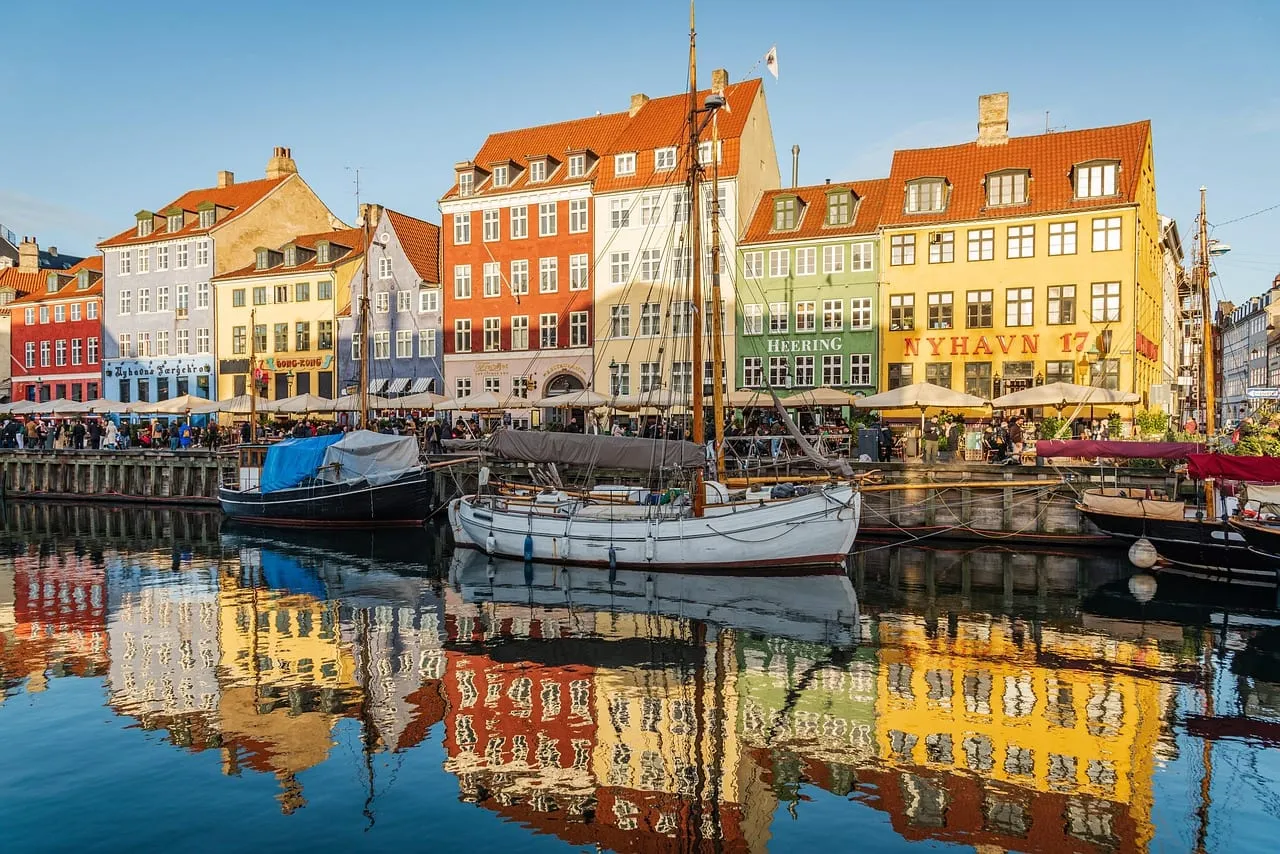
The marathon is a single loop through the middle of the city, mostly on wide boulevards and tree-lined avenues that are closed to traffic for the day. You pass through Indre By (the old centre), Østerbro, Christianshavn, Vesterbro, Nørrebro and Frederiksberg, with the Lakes, Amalienborg, the Marble Church, Dronning Louises Bro, Langebro and Islands Brygge among the landmarks the organiser names. Christianshavn is the colourful canal district; Langebro gives the long view of the skyline.
There are no hills to speak of, so the difficulty is pacing, crowds and the weather. Runners start in colour-coded waves printed on the bib, which spreads the field in the first kilometres, but a 20,000-strong field still means shoulder-to-shoulder running in the early stretches, and narrow city streets and corners later. GPS watches wander between tall buildings; the course is measured on the shortest legal line, so expect your watch to show a little over 42.2 km.
The organiser's table lists 12 drink points on the right-hand side of the road at 3.8, 8.1, 12.3, 16, 19.8, 21.1, 24.3, 27.8, 32.7, 35.3, 35.7 and 38.3 km, all with water and High5 energy drink, bananas at 8.1, 24.3 and 35.7 km, High5 gel at 16 and 27.8 km, and two sponsor power zones at 21.1 km (Faxe Kondi Pro) and 35.3 km (diluted Faxe Kondi Booster). Medic teams are at the start, the finish and every station. Your official time is net, from the moment you cross the start line, and the half-way gate at 21.1 km closes at 3 h net.
How to enter
Entry for 2027 was by free lottery for the first time. It opened on Wednesday 13 May 2026 at 10:00 and ran for three weeks to 3 June, with an equal chance whenever you applied; you could apply alone or as a team of up to three, and each person could enter only once. The organiser got 80,937 applications from over 160 nationalities for a target of about 30,000 starters, and winners had 48 hours to complete the purchase. If the 2028 edition repeats the system, expect the same May to June window, but check the organiser's page because nothing is announced yet.
The 2027 fee was 995 kr plus a 20 kr administration fee per number, roughly 135 euros in all. Numbers are personal: the old resale portal has gone, and you cannot sell, transfer or run on someone else's number. Instead you can buy cancellation insurance for 99 kr when you pay. People who miss the draw may be offered numbers later through official charity partners and travel organisers, which the organiser lists on its site. Runners must be 16 on race day; wheelchairs are allowed, handbikes and baby joggers only by prior agreement.
How to train for it
Train to a flat, even pace
There is almost nothing in the course to break your rhythm, so the race rewards a steady plan. Use long runs on flat roads at goal pace, and settle in the first 5 km even if the crowd and the drum bands pull you faster.
Practise running in a crowd
With about 20,000 starters in 2026, the first kilometres are busy even with waves. Run a few training races or club runs in groups so that weaving, shoulder contact and pace changes do not unsettle you. Start in your own colour block; the waves are there to spread the field.
Rehearse the drinks on the right-hand side
All 12 drink points are on the right of the road and serve High5 energy drink as well as water; gels are only offered at 16 and 27.8 km. Try the drink and gel in long runs, or carry your own, so that the first time you taste them is not at 30 km.
Mind the 3 h half-way limit
A 6 h net finish is allowed, but the half-way gate closes at 3 h net. If you are aiming for 6 h you need to be at 21.1 km well inside that, and your long runs should be on the same pace.
Prepare for a cool, windy morning
The start is 09:30 in May and city temperatures can be in single figures. Train in the clothes you will wear, and plan a throw-away layer for the start pens.
What you need
- Your bib, which is printed at the expo with your name, nationality and wave colour, and your start card (QR code) for the expo, on your phone is fine
- Photo ID, needed together with the start card to collect your number; numbers cannot be collected on race day
- Race bag from the expo: use it to hand in dry clothes at the baggage tent in the Runners Area, with the bag tag that comes with your bib
- A throw-away layer for the start pen on a cold May morning
- Optional own gels and flask if you do not want to rely on High5 gels at 16 and 27.8 km
- Safety pins or sports magnets for the bib, and a note of any medical information to write on the back of the bib
- Headphones are allowed but the organiser advises against them so you can hear officials
Getting there and staying
Copenhagen Airport (Kastrup) has a direct metro to the city, and the metro also runs to the expo at Forum (lines M1 and M2). The organiser recommends walking, cycling or public transport on race weekend and sells a special event ticket in the DOT Rejsebillet app, a small ticket for zones 1 to 4 including the airport and a large one for the whole capital region. Roads on the route are closed.
You must collect your bib at the expo at Forum in Frederiksberg (in 2026: Wednesday 6 May 14:00 to 19:00, Thursday 12:00 to 19:00, Friday 10:00 to 19:00 and Saturday 10:00 to 19:00). Bring photo ID and the emailed start card; the bib is printed on the spot, and there is no pick-up on race day. Hotels in Copenhagen fill early when the marathon is on, so book as soon as you have a number; the organiser lists official travel organisers who sell packages with numbers.
The race is also on the Saturday before with a children's one-mile run (CPH Mini Marathon, over 1,800 children in 2026). After the finish you collect your bag from the baggage tent in the Runners Area.
History
The first Copenhagen Marathon was run in 1980 by the athletics club Sparta Atletik & Løb, with 995 participants, 47 of them women. In the early years the roads were not always closed and the route once ran over Langebro, where the bridge opened twice and the runners had to wait.
It has grown to a field of over 20,000, and in 2026 Mercy Chebwogen broke the women's course record with 2 h 22 min 08 s, while Tadesse Kassa won the men's race in 2 h 08 min 26 s, five seconds off the record. The race is now part of the European Marathon Classics series with seven other European marathons.
Where to find out more
- Lottery and fee for 2027 (opens in a new tab): The organiser's page explaining the lottery, the 48-hour payment window, fee and insurance.
- FAQ (opens in a new tab): Age limit, time limit, bib collection, wheelchairs, start waves.
- Route and drink stations (opens in a new tab): Station positions and what is served at each.
- Expo (opens in a new tab): Opening hours, location at Forum and how bib collection works.
- Results (UltimateLIVE, 2026) (opens in a new tab): Full results for 2026 with split times; used for the median time on this page.
- Results archive (opens in a new tab): Past results and course records.
Questions about Copenhagen Marathon
How do I get a place if I am not drawn in the lottery?
The organiser says unsuccessful applicants may later be able to buy a number from its official charity partners or travel organisers, which it lists on the site. Numbers are personal and the resale portal was removed for 2027, so unofficial sales are not allowed.
Is there a time limit?
Yes: 6 hours net for the marathon and 3 hours net at the half-way point. The organiser says the finish is the last thing to come down and wants everybody over the line, but you may be asked to complete the route on the pavement.
How hilly is the course?
The organiser describes it as flat, through the city centre and neighbourhoods on closed roads. No total climb figure is published.
What did the median finisher run?
3 h 50 min 52 s in 2026, from the official results of 21,652 finishers. The winner ran 2 h 08 min 26 s, and the last finisher took 7 h 15 min.
Can I collect my bib on race day?
No. You must collect it at the expo at Forum on Wednesday to Saturday, with photo ID and your emailed start card.
Similar races
Denmark · Road
Copenhagen Half Marathon (CPH Half)
Copenhagen and Frederiksberg, Zealand
21.098 kmA Sunday in September: 19 September 2027 (2025 edition was 14 September; 2026 was replaced by the World Athletics Road Running Championships on 20 September)
Finland · Road
Helsinki City Marathon
Helsinki, start by the Paavo Nurmi statue and finish in the Olympic Stadium
42.195 kmSecond Saturday of May; 8 May 2027 (weekend 7–8 May)

Iceland · Road
Reykjavík Marathon
Reykjavík city centre, start on Sæmundargata, finish on Geirsgata by the harbour
42.195 kmThe Saturday on or after 18 August, Reykjavík Culture Night: 22 August 2026, 21 August 2027, 19 August 2028
Sweden · Road
adidas Stockholm Marathon
Stockholm: start on Lidingövägen, finish inside Stockholms Stadion
42.195 kmSaturday at the end of May (29 May 2027, preliminary start 12:00; 30 May 2026)

Norway · Road
DNB Oslo Maraton
Rådhusplassen, Oslo
42.195 kmThird Saturday of September; 18 September 2027 (12 September 2026)
Sources
Figures and rules on this page come from these pages, read on the dates given. Organisers change dates, fees and rules: check the official site before you enter.
- Copenhagen Marathon home page (opens in a new tab) (read 2026-10-15)
- Copenhagen Marathon: route and drink stations (opens in a new tab) (read 2026-10-15)
- Copenhagen Marathon: FAQ (opens in a new tab) (read 2026-10-15)
- Copenhagen Marathon: lottery for 2027 (opens in a new tab) (read 2026-10-15)
- Copenhagen Marathon: expo (opens in a new tab) (read 2026-10-15)
- Copenhagen Marathon: results archive (opens in a new tab) (read 2026-10-15)
- Copenhagen Marathon: the race (opens in a new tab) (read 2026-10-15)
- Copenhagen Marathon: about us (opens in a new tab) (read 2026-10-15)
- Copenhagen Marathon: Copenhagen guide (opens in a new tab) (read 2026-10-15)
- News: over 80,000 applied (2026-06-11) (opens in a new tab) (read 2026-10-15)
- News: Kenyan woman breaks course record (2026-05-10) (opens in a new tab) (read 2026-10-15)
- UltimateLIVE: Copenhagen Marathon 2026 results (opens in a new tab) (read 2026-10-15)
- Wikipedia: Copenhagen (climate table, citing DMI) (opens in a new tab) (read 2026-10-15)