Four weeks to start
Four weeks, three sessions a week, all of them outside. Walk, run a little, carry something, climb a hill. By the end you train; you don’t just mean to.
This is the programme for someone who has not trained for a year, or ten, or ever. It assumes nothing: no running, no gym, no kit beyond shoes you can walk in and a rucksack with something in it. What it asks is three sessions a week, outside, for four weeks, and that you do them in whatever weather turns up.
Three sessions a week is not an accident. The NHS Couch to 5K plan, which has taken more beginners to running than any other, is built on three runs a week with rest days between them, and the World Health Organization’s guidance for adults is at least 150 minutes of moderate activity a week, with muscle-strengthening work for everyone. Three sessions of 30 to 60 minutes gets you there by week three. That is the whole ambition of this chapter: a habit that meets the minimum, built outside, with nothing to buy.
If you have a medical condition, are pregnant, or have been told to be careful with exercise, check with a doctor before you start. The programme is gentle, but you know your situation and we don’t.
The three sessions
Each week has the same three sessions. They rotate so that no two are alike, and the weekend one is the longest.
Walk/run. Walk five minutes to warm up, then alternate running and walking for the time in the table, then walk the last few minutes. The run is slow: if you cannot speak a full sentence while running, you are going too fast. The walk is a proper walk, not a shuffle. By week four you run three minutes at a time and the walks are shorter than the runs.
Carry and climb. Put three to five kilos in a rucksack (two litres of water, a few books) and walk to the nearest hill, stairs or steep path. Walk up it, walk down it, and repeat the number of times in the table. The effort on the way up is steady: breathing hard but in control. Walk home with the bag still on. This is the seed of what becomes rucking and real strength work later; the chapter on carrying and rucking explains where it goes.
The long walk. One easy walk, on the weekend, somewhere you want to be: a forest, a lake path, a coast. It grows from 40 minutes to an hour. No bag, no running, no pace. The only rule is that it is outside and that you finish it.
The programme
Minutes are the whole session including warm-up. Effort words: easy means you can talk in full sentences; steady means short sentences; hard is not in this programme.
| Week | Mon | Tue | Wed | Thu | Fri | Sat | Sun | Total |
|---|---|---|---|---|---|---|---|---|
| 1 | Rest | Walk/run 30 min, easy (run 1 min, walk 2 min, 6 times) | Rest | Carry and climb 30 min, easy (3 climbs) | Rest | Rest | Long walk 40 min, easy | 100 min |
| 2 | Rest | Walk/run 30 min, easy (run 1.5 min, walk 1.5 min, 7 times) | Rest | Carry and climb 35 min, steady (4 climbs) | Rest | Rest | Long walk 45 min, easy | 110 min |
| 3 | Rest | Walk/run 35 min, easy (run 2 min, walk 1 min, 8 times) | Rest | Carry and climb 35 min, steady (5 climbs) | Rest | Rest | Long walk 50 min, easy, one hill in it | 120 min |
| 4 | Rest | Walk/run 35 min, easy (run 3 min, walk 1 min, 6 times) | Rest | Carry and climb 40 min, steady (6 climbs) | Rest | Rest | Long walk 60 min, easy | 135 min |
The days are a suggestion. Tuesday, Thursday and Sunday give a rest day between every session, which is what matters; Monday, Wednesday and Saturday works just as well. What does not work is three sessions on three consecutive days and then four days off.
The weekly total grows by about ten per cent a week, which is the oldest rule of thumb in endurance coaching and still a good one. The jump from week three to week four is a little bigger because the base is so small; if it feels too much, make the long walk 55 minutes.
How to adjust
Fewer days. If you can only manage two sessions a week, drop the carry and climb and keep the walk/run and the long walk. Do the two for six weeks instead of four, and add the third session when life allows. Two sessions a week is still a habit, and a habit is what you are building.
A missed week. Repeat the week you missed. Do not jump to the next week to catch up: the point of four weeks is that each one is a little more than the last, and skipping one means two jumps at once. If you missed two weeks, go back to week one. It will feel easy, which is useful information.
Illness. A cold in the head only: walk, don’t run, and skip the climbs until it is gone. Anything below the neck, a fever, or feeling properly ill: stop completely, wait until you have had two normal days, then start again one week back from where you were. Nobody has ever lost fitness in a week of rest. Plenty of people have lost a month by training through something.
Pain. Muscles that ache the day after are normal in week one and two and fade. A sharp pain in a joint or tendon that gets worse as you go is not normal. Stop that session, walk home, and give it three days before you try again at a lower week. If it comes back, see a physio.
What the weather is for
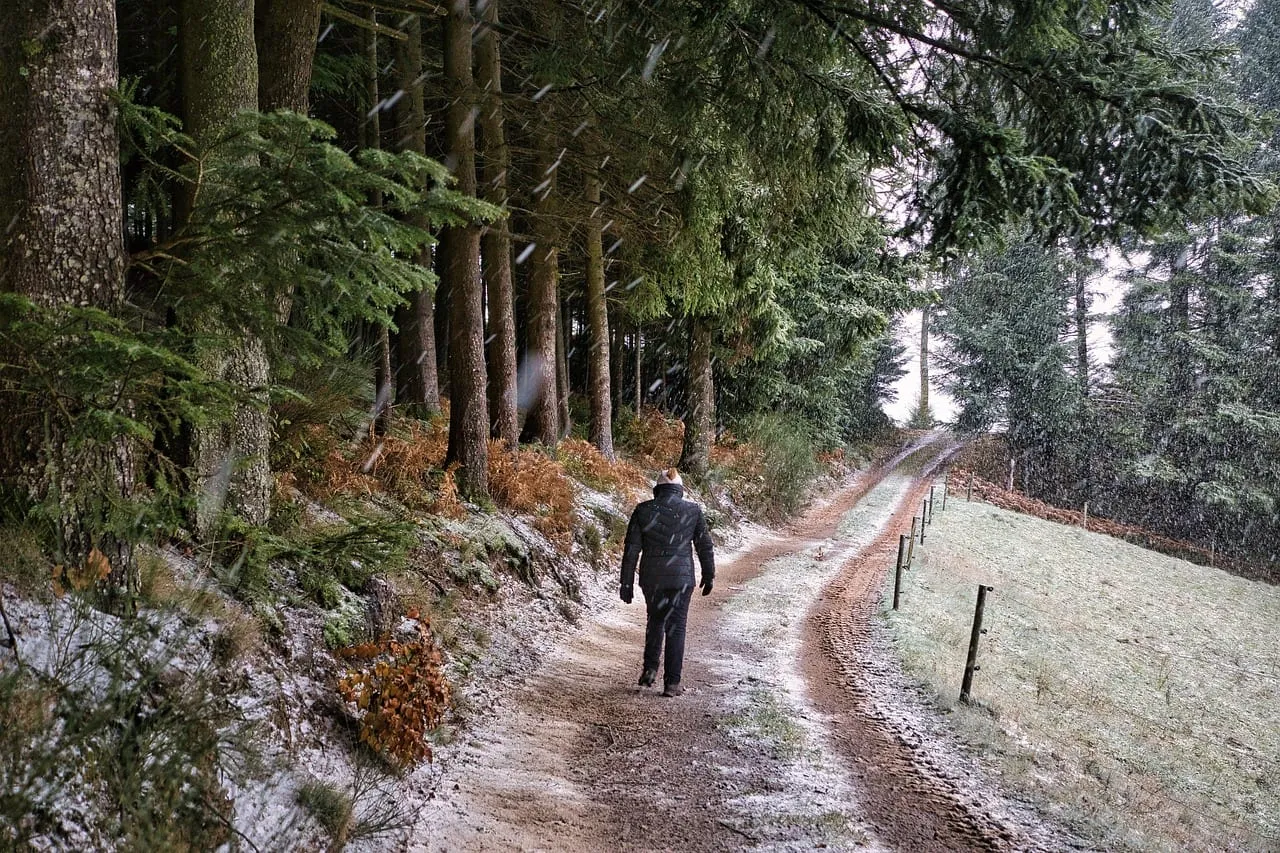
You will be tempted, in week two, when it is raining sideways, to do the session indoors or not at all. Do it outside. This is not bravado; it is the entire reason the programme is built this way. Anyone can train three times in a good week. The person who gets to the start line is the one who trained three times in the bad week, and the first bad week is where that person is made. The chapter on training outside all year covers what to wear, which is less than you think, and the one that matters: start a little cold.
If it is dark, which from November to February it will be, take a head torch and pick a route you know. If it is icy, the long walk stays and the run intervals become brisk walking, because a fall in week two ends the programme. The winter running chapter covers spikes and studs when you want to keep running on ice, but not yet.
What you should notice
By the end of week two, the first minute of running stops feeling like a shock. By week three, the climbs are the session you look forward to, because they are short and you can feel the result. By week four, an hour’s walk is simply an hour outside, and you have a route you like.
What you will not notice is a change in the mirror or on the scales, and this programme makes no promises about either. It is about the sessions happening. Three a week, four weeks running, twelve sessions done in whatever the sky did. That is the base everything else is built on, and it is more than most people ever lay down.
Next
Go on to the twelve-week base programme, which adds strength days, one interval session a week and a weekend outing that grows to two and a half hours. If you want a goal to hang it on, look at the races and challenges and pick one a year away; the chapter on your first Nordic race explains how to choose one you will finish.
Questions
Can I start this programme if I have never run?
Yes. That is who it is for. The running in week one is a minute at a time between walking, and the walking is the point. If a minute of running is too much, walk the whole session for the first week and start the run intervals in week two. The programme still works.
How heavy should the thing I carry be?
Light enough that you can talk, heavy enough that you notice it. For most people that is three to five kilos in a rucksack, which is a couple of litres of water or a few books. Keep it there for the whole four weeks. The weight goes up in the base programme, not here.
Do I need running shoes?
Any shoe you can walk an hour in is fine for these four weeks, and trainers with a bit of grip are better than road shoes on wet paths. Do not buy anything before week three. By then you know whether you will keep going, and what the ground under you is like.
What if I miss a session?
Nothing. Do the next one on the next day you can, and keep the rest days between sessions. If you miss a whole week, repeat the week you missed rather than skipping ahead. Four weeks is a guide, not a deadline.
What comes after week four?
The twelve-week base programme, which turns three sessions into five, adds one interval day and two strength days, and grows the weekend outing to two and a half hours. If you finished week four and felt fine, go straight on. If it was hard, repeat weeks three and four first.