Your first Nordic race
A first race is not about the time. It is about standing at a start you chose well, with the right things in your bag, and crossing the line with something left. Here is how to pick it and get there.
Pick a race you can finish
The first race you choose decides whether there is a second one. Choose it so that finishing is likely and the day is good, not so that it impresses anyone. The rule of thumb is simple: your longest training outing should be about two thirds of the race’s mid-pack time, done on similar ground, more than once. For a first race that means something that takes two to four hours in the middle of the field, a half-day, which is what the three programmes in this guide build towards.
Every race on this site is rated on four meters, each from 1 to 5, and they are built for exactly this decision. Read them on the race page and against each other.
Duration is how long a mid-pack finisher is out there, from the official results: a 2 is one to two and a half hours, a 3 is two and a half to five, and a first race lives there.
Terrain is how hard the ground, the water or the course itself is, from flat road or groomed trail at 1 through proper forest trail at 3 to mountain, open water and obstacle courses at 4; pick the terrain you have trained on, not the one you admire.
Cold is how cold and exposed you will be at the normal race-time conditions, from a mild summer day at 1 to deep winter or ice swimming at 5; make your first race in a season you have trained through.
Cut-offs is how hard it is to get in and to be allowed to finish, from no cut-offs at 1 to a qualifying standard at 5; for a first race choose a 1 or a 2, where walkers finish and nobody is pulled off the course.
The full method is on How we rate toughness, and the toughest races in the Nordics orders every race by those four meters. Read that ranking from the bottom, not the top. The events at the top, the mountain triathlons and the long swimruns, are where you might be in five years. The ones near the bottom, the 20 km trail race, the 30 km ski race, the short swimrun, the harbour swim, are the first race.
Then go to the events pages and filter by discipline and month. Nearly every big Nordic event runs a shorter distance on the same weekend, with the same finish line and the same atmosphere, and that shorter distance is often the perfect first race: you get the occasion without the full day.
Enter in time
Nordic races fill early. The big ski classics and the well-known trail and swimrun races open entries nine to twelve months ahead, and the most popular are gone within a day; this site’s method rates a race that sells out within a day of entries opening as at least a 3 on cut-offs for that reason alone. Smaller races take entries until a few weeks before, often with a cheaper fee for entering early. Each race page says when entries open, what it costs and whether a licence, a team-mate or a medical certificate is needed; swimrun is entered in pairs, some cycling races want a one-day licence, and a few events ask for a previous result.
Put the opening date in your calendar when you decide, and book accommodation the same day you enter. Race towns in the Nordics are small, and the night before a big race every bed in Mora, Lillehammer or Kiruna is taken months ahead.
Train for the race, not around it
The programmes do the work: four weeks to start, twelve weeks of base, and sixteen weeks to race day, which ends in a taper and a race-week checklist. Three principles sit on top of them.
Make the last eight weeks specific. If the race is on trail, the long outings are on trail. If it is on skis, you are on skis, not running, however good the running feels. If it is a swimrun, you are running in a wetsuit with the paddles in your hand at least once a week, because that is the odd part.
Do one outing at about two thirds of the race’s mid-pack time, three to four weeks before the start, in the kit you will race in, eating what you will eat. Treat it as the rehearsal. Whatever rubbed, slipped, leaked or sat badly on the stomach gets fixed in the three weeks that remain.
Then taper. The last two weeks are shorter sessions at the same effort, not more. Nothing you do in race week makes you fitter; several things can make you tired.
Kit
The race’s mandatory kit list is law, and the officials check it. Lay it out on the floor a week before, in the order the list gives it, and pack it. Then the two rules that cover everything else.
Nothing new on race day. Shoes with a hundred kilometres in them, clothes worn on long outings, food you have eaten on the move, a pack you have run with. The sock you bought at the expo is for next month.
Dress for the forecast at the start, with one layer more in the bag than you think you need. A trail race in the mountains wants a wind-proof jacket, a hat, gloves, a whistle and a charged phone whatever the morning looks like. A ski race wants a thin wind-proof front and a drop bag with dry clothes at the finish. A swimrun wants the wetsuit, paddles, pull buoy and tow line that you have trained in, as a pair, in cold water. An obstacle race wants clothes you do not mind ruining and shoes that grip when wet. Anti-chafing cream on everything that rubs, pins or a belt for the number, and the food in a pocket you can reach without stopping.
Travel and the night before
Bib collection is usually the day before, in the race town, so plan to arrive by the afternoon. Many Nordic point-to-point races start a bus ride from the finish; read the logistics section on the race page and know which bus, from where, at what time. Eat the dinner you always eat. Lay the kit out again. Set two alarms.
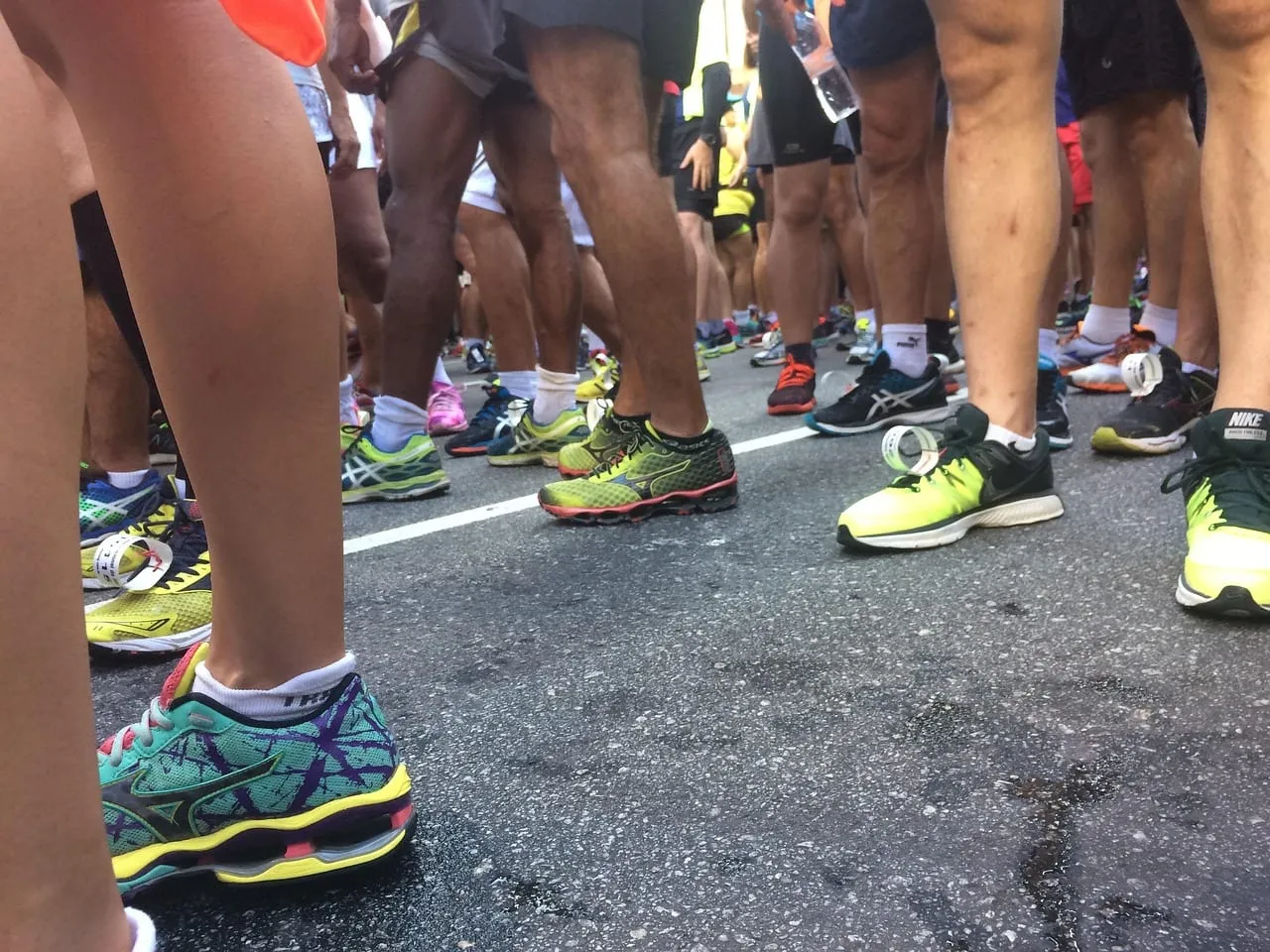
The night two nights before the race is the one that matters for sleep; the night before is always poor and it does not hurt. Breakfast is two to three hours before the start and it is the breakfast you have tested. Get to the start early enough to queue for a toilet twice and stand in your pen with ten minutes to spare, cold, which is normal, and a little scared, which is also normal.
You do not need to be fast. Most Nordic mass-participation races have generous cut-offs and a strong culture of finishing rather than racing, and the field around you is mostly people doing exactly what you are doing. Start at the back of your wave and let the first twenty minutes be slower than feels right.
The day
Start slower than the people around you. Every first-timer goes out too fast, and the price is paid in the last third. Walk the climbs on trail; nobody runs them well in the middle of the field. Eat something small every half hour from the first hour, before you feel you need it, and drink at every station. The aid stations in Nordic races are generous: blueberry soup and buns at the ski races, broth and salt at the long trail runs, bananas everywhere. Walk through them; the thirty seconds costs nothing.
Know the cut-off times before you start and write them on your hand with the distance they belong to. Then forget them unless you are close.
Around two thirds of the way, most people hit a low patch: tired, hungry, wondering why. Eat, walk for five minutes, and it passes. It always passes. The last tenth is the best part of the day.
At the finish: eat, change into dry clothes at once, warm up, and if there is a sauna, use it the way the cold-water chapter describes, after food and water. Then sit down and let it land. You did the thing most people only talk about.
After
Write down what happened while you remember it: what you ate, what rubbed, where the low patch came, what you would tell someone doing it next year. If you want to tell them yourself, our ambassadors do exactly that and get published under the race. Then take a week off and open the events pages again. There is a reason the second race is the one most people enter the same evening.
Questions
How do I know if I am ready for my first race?
If your longest training outing is about two thirds of the race's mid-pack time, on similar ground, and you have done it more than once, you are ready. A three-hour race wants a two-hour outing behind it. The sixteen-week programme gets you there; the race page tells you the mid-pack time.
How far ahead do I need to enter a Nordic race?
Nine to twelve months for the big ones. The ski classics and the famous trail and swimrun races open entries about a year ahead, and the most popular fill within hours or days. Smaller races take entries until a few weeks before. Each race page says when entries open and how fast they go, and the cut-off meter tells you if a lottery or a qualifying standard is involved.
What should I eat before and during a first long race?
Before: the breakfast you have eaten before your long training outings, two to three hours before the start. During: something small every half hour from the first hour, tested in training, and whatever the aid stations serve if you have tried it. Nothing new on race day is the whole rule.
What if I am last?
Someone is, and in a Nordic race they get the same cheer. Most mass-participation races here have generous cut-offs and a culture built around finishing rather than racing. Pick a race rated 1 or 2 on the cut-off meter and the question goes away.