Iceland · Trail running
Laugavegur Ultra Marathon
Landmannalaugar to Þórsmörk (Húsadalur), Fjallabak, southern highlands
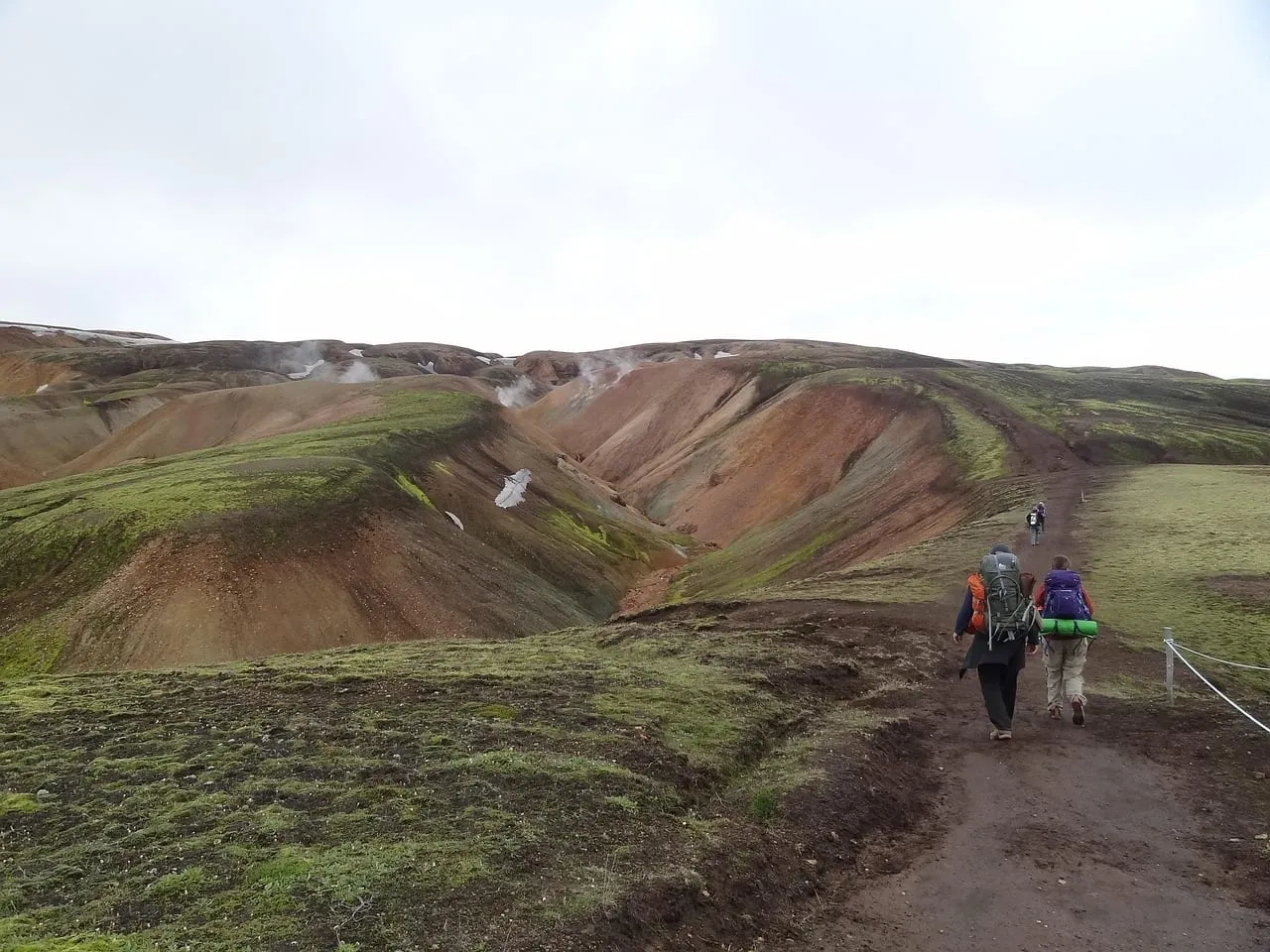
The Laugavegur Ultra Marathon is a 55 km point-to-point mountain race along Iceland's best-known hiking trail, from the hot springs at Landmannalaugar over the Hrafntinnusker plateau and down to the birch woods of Þórsmörk, a route hikers normally take four days over. It is run once a year on a Saturday in mid July, with a field of around 700 to 850 and a finish rate that has been high because entry needs a 370 ITRA performance index, places go partly by index and partly by lottery, and three cut-offs are enforced without exception. Expect snow, geothermal mud, several river wades and July temperatures of 7 to 8 °C on the high ground.
Official site (opens in a new tab)No. 11 of 41 in the toughness ranking
The race in brief
- Distance
- 55 km
- Climb
- 1,400 m
- Format
- 55 km point to point (ITRA measures 53.6 km), Landmannalaugar to Húsadalur in Þórsmörk, five start groups by ITRA index 5 minutes apart from 09:00, runners released one at a time within each group
- When
- A Saturday in mid July: 11 July 2026, 17 July 2027, 15 July 2028
- Mid-pack time
- 7 h 22 min (median of 699 ranked finishers, 2026)
- Cut-off
- Leave the Álftavatn aid station (22 km) within 4 h and Emstrur (38 km) within 6 h 30 min of your start group's gun; finish within 9 h 15 min or you are recorded as DNF
- Entry fee
- ISK 62,250 (Single fee for 2027 (about 430 euros), charged at registration and refunded by 3 December if you do not get a place; 75% back until 30 December, 50% until 1 March, then only a name change (ISK 2,500) between 1 March and 1 June)
- Field
- 699 ranked finishers (2026 results); ITRA lists 850 participants for 2026; 510 started and 497 finished in 2024
- First held
- 1997
- Other distances
- 55 km only; there is no shorter option
- Organiser
- Reykjavík Sports Union (Íþróttabandalag Reykjavíkur, ÍBR)
Next edition: 2027-07-17 · Entries open 11 November 2026 at 12:00 GMT and close at midnight on 18 November; 370 ITRA performance index required; places by index first (evenly split between genders), the rest by lottery, announced 25 November; waiting list for cancellations until 1 March · Entries (opens in a new tab)
Checked 2026-10-14
How tough is it?
Four meters, each 1 to 5, rated by our published method. The basis under each one shows the figures behind the score. How we rate.
Median finishing time 7 h 21 min 33 s at rank 350 of 699 ranked finishers in the official Corsa results (2026-07). Winner 4 h 06 min, first woman 4 h 14 min (course record), 100th place 6 h 04 min, 500th place 8 h 03 min, last ranked finisher 9 h 52 min. The organiser's design limit is 9 h 15 min. As of 2026-07.
ITRA course data: 53.6 km, +1,400 m and -1,810 m, mountain level 3 (2026-07). About 26 m of climb per km, most of it in the first 10 km to Hrafntinnusker (just under 500 m). Surfaces are sand, gravel, grass, snowfields and ice near Hrafntinnusker, a muddy geothermal slope before Álftavatn, a steep rope-assisted descent to the Fremri-Emstruá bridge and a wade of the Þröngá up to a metre deep. Marked with wooden posts, no technical rock. As of 2026-07.
Organiser states an average of 7 to 8 °C on the trail in July, with wind, rain and snow possible, and warns of hypothermia on a wet day (runners' preparation page, 2026). Mandatory waterproof jacket, space blanket and whistle checked at the start, and the race director can order extra layers; snow lies on the plateau in most years. Borderline 2 to 3: it is summer at sea level but highland exposure at 1,000 m. As of 2026-07.
Entry needs a 370 ITRA performance index; a set number of places go to the highest indexes and the rest by lottery, with a waiting list (record registrations in November 2024, 2026 entries closed after one week). Cut-offs of 4 h at Álftavatn and 6 h 30 min at Emstrur are enforced without exception and the organiser reports more runners being stopped in recent years. Finish rate 497 of 510 starters in 2024 (97%); 699 ranked of around 850 entries in 2026. Borderline 4 to 5 because of the qualifying standard. As of 2026-07.
The course
You start at 09:00 in Landmannalaugar at about 600 m with the first of five colour-coded groups, and the hardest section comes first: roughly 10 km and just under 500 m of climb to the Hrafntinnusker hut, through steaming geothermal ground and a 500 m stretch of snow and ice just before the aid station. Most runners walk the steep pitches here. The organiser suggests spending about 20% of your target time on this section and another 20% on the next, the 12 km over the highest part of the course to Álftavatn, where sand alternates with snow patches, a short muddy geothermal slope needs care, and a sharp descent brings you to the lake and the first river, Grashagakvísl, crossed on stepping stones.
At Álftavatn (22 km) you must check in and be gone within 4 hours of your group's gun. The 16 km to Emstrur is the flattest part, long stretches of black sand with several streams and the biggest river, Bláfjallakvísl, where cables and rescue-team staff help you across and your optional mid-point bag waits with dry shoes. Then a long descent into Emstrur (38 km), the second cut-off at 6 h 30 min, where a doctor is stationed.
The last 17 km drop about 300 m but are not easy: a steep rope-assisted path down to the bridge over Fremri-Emstruá, a rolling section, the final climb of Kápa from whose top you see the Þórsmörk valley, then the Þröngá wade (up to a metre deep, with a rope) and 4 km of undulating woodland path to the finish at Húsadalur. The organiser says this is where runners who went out too hard in the first 10 km lose the most time.
Timing is by chip in the bib with gates at the start, Álftavatn, Emstrur and the finish; gun time of your group counts for cut-offs, chip time for your personal result. Aid stations are at Hrafntinnusker (10 km), Álftavatn (22), Sandar (32, water only, 300 ml each), Emstrur (38), Ljósá (49, 450 ml each), Þröngá (50) and the finish, with water, sports drink, cola from Álftavatn on, bananas, chocolate and pretzels at the main ones. No cups are provided; staff fill your own bottle or cup.
How to enter
Registration for 2027 opens at 12:00 GMT on 11 November 2026 and closes at midnight on 18 November. You need a 370 ITRA performance index, which is roughly what finishing Laugavegur in 9 h 15 min earns; the organiser checks every entry against the ITRA database. A set number of places go to the highest-index runners, split evenly between genders, and every other valid entry goes into a lottery drawn with the Icelandic athletics federation (FRÍ). Results are announced on 25 November; unlucky entrants go on a waiting list that is used for cancellations until 1 March. If you want to start with friends you must register together, and the group is placed by its lowest index. Runners from countries without ITRA-scored races can write to the organiser with proof of a comparable trail run of at least 30 km in the last 36 months.
The 2027 fee is ISK 62,250 (about 430 euros), paid by card when you apply and refunded by 3 December if you get no place. It includes timing, a long-sleeved shirt, aid stations, toilets along the route, a doctor at Emstrur and the finish, showers and shelter tents in Húsadalur, luggage transport from start to finish, a medal and transport back to Reykjavík if you miss a cut-off. Not included: the race bus, breakfast at Hrauneyjar and the hot meal at the finish, all booked on My Page between 1 February and 1 July. Cancelling returns 75% until 30 December and 50% until 1 March; from 1 March to 1 June you can instead transfer the entry to another runner who meets the ITRA requirement for ISK 2,500. Entries cannot be deferred to the next year.
How to train for it
Build to 6 to 7 hours on your feet
The organiser's guidance is a marathon plan of 20 weeks or more at 50 to 70 km a week, plus a weekly mountain hike or run and regular strength work. The median finisher is out for 7 h 22 min, so long back-to-back days with hiking in them matter more than speed.
Practise hiking the first 10 km
Almost 500 m of the course's climb is in the first fifth, to Hrafntinnusker, and the organiser says the commonest mistake is running it too fast. Train power-hiking steep sand and snow, and plan to spend about 20% of your target time on that section.
Run on sand, snow and wet feet
Long stretches between Álftavatn and Emstrur are soft black sand, and your feet will be wet from Grashagakvísl onwards with the Þröngá wade near the end. Do long runs in wet shoes and wool socks, and test gaiters, so blisters and cold feet are not new on the day.
Work backwards from the cut-offs
You must leave Álftavatn (22 km) within 4 h and Emstrur (38 km) within 6 h 30 min of your group's gun time. A 9-hour finisher has little slack at Álftavatn given the climb, so rehearse the pace that gets you to 22 km inside 3 h 45 min on similar terrain.
Train your eating with gels in a flask
The organiser asks runners to decant gels into a soft flask rather than carry sachets, which blow away on the plateau, and every gel or bar you do carry must be marked with your bib number. Get used to that system in training; being unable to take food after 5 hours is the usual reason for a slow second half.
What you need
- Mandatory, checked at the start: space blanket, whistle and a mobile phone with 112 saved; missing any of them adds 60 minutes to your time
- Mandatory: waterproof jacket and a reusable cup or bottle (no cups at aid stations)
- Must be available if the race director requires it: long-sleeved top, long trousers, gloves and a hat covering the ears and neck
- Broken-in trail shoes with grip; low gaiters keep snow and gravel out on the Hrafntinnusker section
- Wool or similar socks, and dry socks and shoes in your optional mid-point bag at Bláfjallakvísl
- A soft flask for gels and every gel or bar marked with your bib number; litter on the trail can mean disqualification
- Poles are allowed but you must start at the back of your group and carry them to the finish
- In the finish bag: warm dry clothes, a large towel and sandals, because the changing tent and showers at Húsadalur are outdoors
Getting there and staying
There is no public transport to the start and the roads to both Landmannalaugar and Þórsmörk are unsurfaced F-roads with river crossings, so nearly everyone takes the race bus (return ticket only, booked on My Page, not included in the fee). It leaves from Múlavegur 1 by the ice rink in Laugardalur, Reykjavík, at 04:30 for the yellow, red and green groups and 05:00 for blue and pink, stops 30 minutes for breakfast at Hrauneyjar and reaches Landmannalaugar between 08:15 and 09:00. There is nothing indoors at the start except toilets, so dress for running on the bus. Keflavík airport is about 50 km from Reykjavík.
Bib pick-up is at Laugardalshöll on Thursday 15 July 2027 from 15:00 to 17:30 and Friday 16 July from 14:00 to 16:30 only, with ID and a completed emergency-contact section, so you must be in Reykjavík by Friday afternoon. Hand your finish bag in at Landmannalaugar with the tag from your bib; it is driven to Húsadalur. A separate mid-point bag can be sent to Bláfjallakvísl (32 km).
At the finish there are tents, outdoor showers and a hot meal if you ordered it. Race buses back to Reykjavík leave between 17:30 and 21:00, arriving from about 20:30 to midnight; you can also use the race ticket on the Sunday or Monday service and stay a night in Þórsmörk, where the Volcano Huts in Húsadalur sell accommodation. Friends can meet you there only with their own highland bus ticket, and a Krossá river shuttle runs from Húsadalur on race day (ISK 3,000 return). Runners stopped at a cut-off are driven to Hvolsvöllur and on to Reykjavík, with a wait of a few hours.
History
The race was first run in 1997 along the Laugavegur hiking trail that the Icelandic Touring Association (Ferðafélag Íslands) opened between its huts in the 1970s, and the Reykjavík Sports Union has organised it since 2003. The field grew from about 400 starters in 2015 to 500 to 580 in the early 2020s and 699 ranked finishers in 2026; record registrations in November 2024 led to the current index-plus-lottery entry system.
The men's course record of 3 h 59 min 13 s was set by Þorbergur Ingi Jónsson in 2015. Tove Alexandersson set the women's record of 4 h 14 min 08 s in 2026, finishing third overall; Andrea Kolbeinsdóttir had won the women's race five years running from 2021 to 2025. A bonus of ISK 50,000 is paid for a course record.
Where to find out more
- Registration and key dates (opens in a new tab): The organiser's page with the November entry window, ITRA requirement, refund steps and what the fee includes.
- Cut-off times (opens in a new tab): How the Álftavatn and Emstrur cut-offs are applied and what happens to runners who are stopped.
- Route description (opens in a new tab): The organiser's section-by-section description with suggested time splits.
- The race bus (opens in a new tab): Departure times from Laugardalur, return options from Þórsmörk and the Krossá shuttle.
- Official results 2026 (Corsa) (opens in a new tab): Full ranked results with splits, used for the median time on this page.
- ITRA race page (opens in a new tab): ITRA's course data (distance, climb, time limit) and where finishers' performance index scores are published.
Questions about Laugavegur Ultra Marathon
Do I need ITRA points to enter?
Yes. Since the 2025 edition you need a 370 ITRA performance index when you apply in November, and the organiser checks it against the ITRA database. The highest-index runners are given places first and everyone else goes into a lottery. If your country has no ITRA-scored races, email the organiser with proof of a trail run of at least 30 km in the last 36 months showing you can finish 55 km in under 9 h 15 min.
What happens if I miss a cut-off?
You must stop. Runners who have not left Álftavatn (22 km) within 4 hours or Emstrur (38 km) within 6 h 30 min of their group's gun are recorded, kept at the aid station until everyone has passed, and driven to Hvolsvöllur and on to Reykjavík, a journey of several hours. Nobody is allowed to continue alone, and there is no transport from Emstrur to the finish in Þórsmörk. Finishing after 9 h 15 min is recorded as DNF.
Can I drive to the start or finish myself?
Only with a proper 4x4; both Landmannalaugar and Húsadalur are reached by gravel F-roads with unbridged rivers, and most rental companies forbid those roads. Day visitors to Landmannalaugar needed a paid parking reservation in summer 2025. The race bus from Reykjavík (04:30 or 05:00) is what nearly everyone uses, and it is a return ticket you can also use on the Sunday or Monday.
How much does it cost in total?
The 2027 entry is ISK 62,250 (about 430 euros). On top of that come the race bus, the breakfast stop at Hrauneyjar and the hot meal in Húsadalur, all bought on My Page between 1 February and 1 July, plus two nights in Reykjavík since bib pick-up is on Thursday or Friday only.
Is it really 55 km?
The organiser calls it 55 km; ITRA's measured course for 2026 is 53.57 km with 1,400 m of climb and 1,810 m of descent. Whichever figure you use, the median finisher in 2026 took 7 h 22 min, and the first 10 km to Hrafntinnusker hold about a third of the climb.
Similar races

Iceland · Trail
Hengill Ultra
Hveragerði and the Hengill volcanic massif, 45 km east of Reykjavík
53 kmFirst weekend of June: 5 to 6 June 2026, 4 to 5 June 2027
Iceland · Road
Reykjavík Marathon
Reykjavík city centre, start on Sæmundargata, finish on Geirsgata by the harbour
42.195 kmThe Saturday on or after 18 August, Reykjavík Culture Night: 22 August 2026, 21 August 2027, 19 August 2028
Sources
Figures and rules on this page come from these pages, read on the dates given. Organisers change dates, fees and rules: check the official site before you enter.
- Laugavegur Ultra Marathon, official site (English home) (opens in a new tab) (read 2026-10-14)
- Laugavegur Ultra Marathon: registration 2027 (opens in a new tab) (read 2026-10-14)
- Laugavegshlaupið: skráning 2027 (Icelandic, fee) (opens in a new tab) (read 2026-10-14)
- Laugavegur Ultra Marathon: cut-off time (opens in a new tab) (read 2026-10-14)
- Laugavegur Ultra Marathon: race rules (opens in a new tab) (read 2026-10-14)
- Laugavegur Ultra Marathon: route description (opens in a new tab) (read 2026-10-14)
- Laugavegur Ultra Marathon: runners' preparation (opens in a new tab) (read 2026-10-14)
- Laugavegur Ultra Marathon: is this race for you? (opens in a new tab) (read 2026-10-14)
- Laugavegur Ultra Marathon: race day and programme 2027 (opens in a new tab) (read 2026-10-14)
- Laugavegur Ultra Marathon: pace groups and bibs (opens in a new tab) (read 2026-10-14)
- Laugavegur Ultra Marathon: service on the route (opens in a new tab) (read 2026-10-14)
- Laugavegur Ultra Marathon: timing (opens in a new tab) (read 2026-10-14)
- Laugavegur Ultra Marathon: the race bus (opens in a new tab) (read 2026-10-14)
- Laugavegur Ultra Marathon: race package pick-up (opens in a new tab) (read 2026-10-14)
- Laugavegur Ultra Marathon: luggage (opens in a new tab) (read 2026-10-14)
- Laugavegur Ultra Marathon: ticket transfer 2027 (opens in a new tab) (read 2026-10-14)
- Laugavegur Ultra Marathon: prizes and course records (opens in a new tab) (read 2026-10-14)
- Laugavegur Ultra Marathon: FAQ (opens in a new tab) (read 2026-10-14)
- Laugavegur Ultra Marathon: about us (opens in a new tab) (read 2026-10-14)
- Laugavegur Ultra Marathon: results 2026 (opens in a new tab) (read 2026-10-14)
- Laugavegur Ultra Marathon: past results (opens in a new tab) (read 2026-10-14)
- Laugavegur Ultra 2024 (news, 18 July 2024) (opens in a new tab) (read 2026-10-14)
- Registration opens on November 5 (news, 6 October 2025) (opens in a new tab) (read 2026-10-14)
- Record registrations for the 2025 race (news, 14 November 2024) (opens in a new tab) (read 2026-10-14)
- Waiting list for the 2025 race (news, 20 November 2024) (opens in a new tab) (read 2026-10-14)
- Laugavegur Ultra Marathon 2026 information booklet (PDF) (opens in a new tab) (read 2026-10-14)
- Corsa results: Laugavegur Ultra Marathon 2026, 55K overall (opens in a new tab) (read 2026-10-14)
- ITRA: Laugavegur Ultra Marathon 2026 race details (opens in a new tab) (read 2026-10-14)