Norway · Trail running
Lofoten Ultra-Trail
Kirkefjorden (Moskenes) to Svolvær, Lofoten, Nordland
Lofoten Ultra-Trail is a series of point-to-point trail races that all finish in Svolvær, the longest being the 100 Miles (about 165 km with 7,000 m of climb) that starts by boat in Kirkefjorden at noon on a Friday and crosses the whole archipelago under the midnight sun. It is a fully supported, marked race with no crew allowed, a UTMB Index race and an ITRA points race. The 100 Miles is hard to finish: 51 of the 130 athletes listed finished in 2026 and the median finisher took almost 35 hours, while shorter distances of 12, 24, 48 and 88 km are available the next day.
Official site (opens in a new tab)No. 2 of 41 in the toughness ranking
The race in brief
- Distance
- 165 km
- Climb
- 7,046 m
- Format
- 100 Miles point to point from Kirkefjorden to Svolvær, marked course, boat to the start, organiser's service points only, two special-needs bags, limited to 150 athletes; start Friday 12:00
- When
- Week 22, starting Friday; 100 Miles on 4 June 2027, shorter distances on Saturday 5 June
- Mid-pack time
- 34 h 41 min (median of 51 finishers, 2026; 33 h 41 min in 2025)
- Cut-off
- Napp (56 km) 14 h after the start, Kleppstad (144 km) 32 h with a medical check, Kongsmarka (158 km) 36 h
- Entry fee
- 3 790–4 990 kr (100 Miles, 2027 edition: 3 790 kr until 30 November 2026, 4 390 kr to 31 March 2027, 4 990 kr to 28 May)
- Field
- 130 athletes listed and 51 finishers in the 100 Miles (2026); 106 listed and 55 finishers (2025); capped at 150
- First held
- 2016
- Other distances
- 100 Miles 165 km (Friday 12:00) · 100 Miles relay, 10 stages · 50 Miles 88 km from Leknes (Saturday) · 50 Miles relay · 48 km from Torvdalshalsen · 24 km from Gimsøy · 12 km from Svolvær · Kids race
- Organiser
- The Arctic Triple (Lofoten Ultra-Trail is week 22 of the Arctic Triple series with Lofoten Skimo and Lofoten Triathlon)
Next edition: 2027-06-04 · Registration for 2027 opened on 30 August 2026 at 18:00; the price steps up on 1 December and 1 April, and the 100 Miles is limited to 150 athletes · Entries (opens in a new tab)
Checked 2026-10-15
How tough is it?
Four meters, each 1 to 5, rated by our published method. The basis under each one shows the figures behind the score. How we rate.
Median finishing time of the 100 Miles 34 h 41 min among the 51 finishers of 2026 (UTMB Index results, 2026-05), quartiles 30 h 22 min and 36 h 57 min, last finisher 38 h 32 min; 2025 median 33 h 41 min among 55 finishers. The winner took 22 h 42 min. The Saturday distances are far shorter. As of 2026-05.
Organiser and UTMB give about 165 km and 7,046 m of climb. The manual describes technical trails over mountain passes, a stretch with no trail, a fishermen's path with rock climbing and a short ladder, a ridge from Jordtind to Nonstind, and possible snow on the trail, with some road and gravel sections. Marked course. Race manual, 2026-10. As of 2026-10.
Late May to early June: Svolvær airport averaged 7.5 C in May 2026 against a normal of 6.6 C, and 10.1 C is the June normal; the strongest gust in May 2026 was 22.5 m/s (Yr station table, 2026-10). Rain is likely, there can be snow on higher trails, and the race runs for around 35 hours under the midnight sun. Mandatory: waterproof jacket and trousers, long base layers, hat, gloves, emergency blanket. Borderline with 2. As of 2026-10.
Three cut-offs (14 h at 56 km, 32 h at 144 km with a medical check, 36 h at 158 km) against a median of 34 h 41 min, and a high DNF rate: 39 per cent of the 130 listed athletes finished in 2026 and 52 per cent of 106 in 2025 (UTMB Index results). Entry is open on a first-come basis up to 150 athletes and was not sold out in 2025 or 2026. Borderline with 3 since the cut-offs are loose. As of 2026-05.
The course
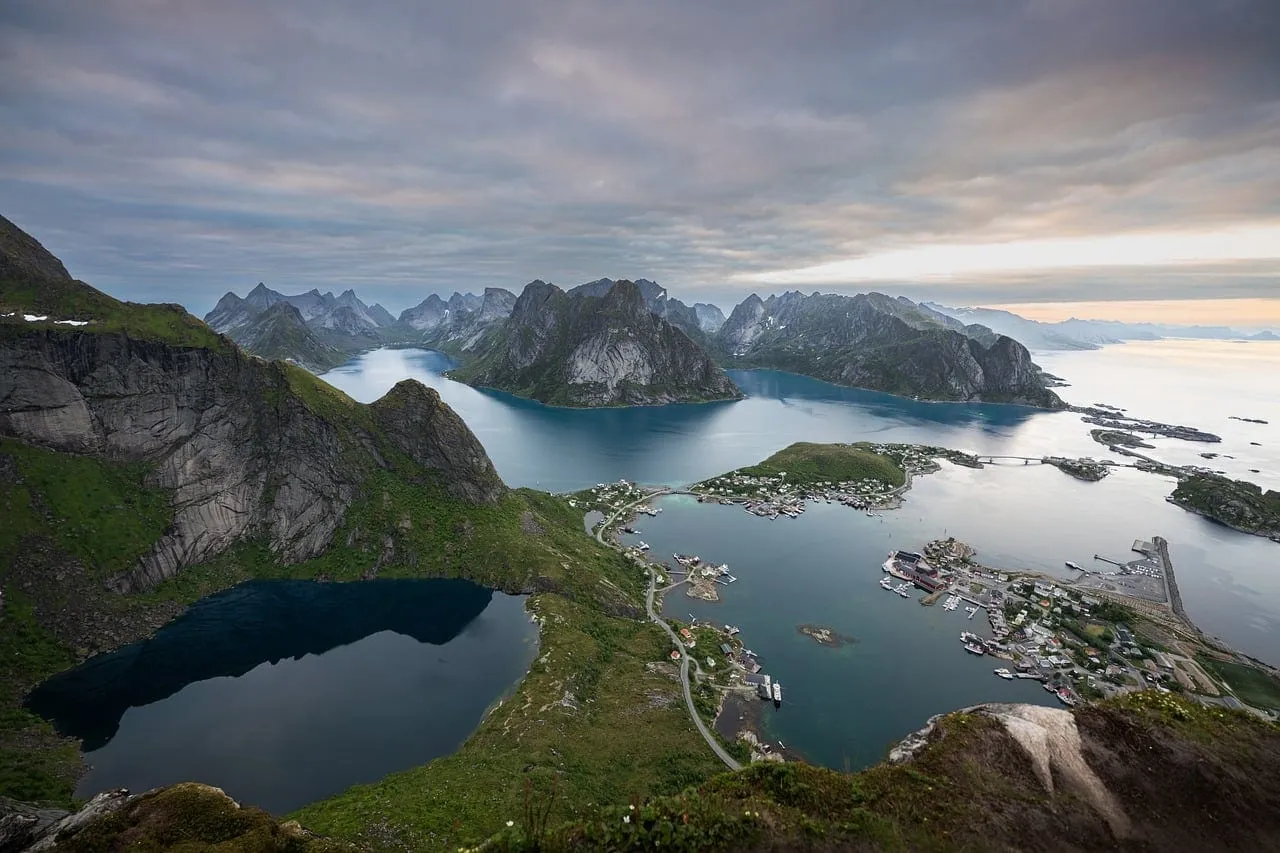
The 100 Miles starts at noon on Friday in Kirkefjorden, at the bottom of Reinefjorden, after a roughly 20 minute boat ride from Reine. The first 23 km to Fredvang are the hardest of the day: several mountain passes, technical trail, and the beach at Kvalvika, where you run on the sand. From Fredvang the route follows asphalt and then gravel to Nesland, and a historic fishermen's path with a short ladder to the village of Nusfjord, then a coastal trail with many ups and downs to Napp at 56 km, where the first cut-off is 14 hours after the start.
From Napp you run through a 1.8 km underwater tunnel to Offersøy, take the trail around Offersøykammen (hardly a trail in the middle section) to Leknes, then road over Hagskaret to Brustranda, and a mountain stretch to Torvdalshalsen at 117 km, the second special-needs bag. The leg from Torvdalshalsen to Kleppstad (about 30 km) crosses the ridge of Daltuva where the trail is less visible, then 10 km of asphalt to the Gimsøystraumen bridge. Kleppstad is the crucial cut-off at 144 km, 32 hours after the start, with a medical check.
The final 16 km from Kleppstad to Svolvær contain the toughest finishing climbs: gravel road to Olderfjorden, the technical ridge from Jordtind to Nonstind, a pass behind Dronningtinden down to a power station (the Kongsmarka checkpoint, 36 hours), and then the last mountain, Tjeldbergtinden, before the tunnel and the harbour finish in Svolvær town square. The route can change with the weather, and you carry mandatory equipment for the entire race; the organiser provides all support at ten service points with water, sports drink, soup, sandwiches and hot drinks, and external support is only allowed at service points 4 and 7 where the special-needs bags are.
The Saturday races are shorter versions of the same trails into Svolvær: the 50 Miles (88 km) starts at Leknes at 09:00, the 48 km at Torvdalshalsen at 13:00, the 24 km on Gimsøy at 16:00 and the 12 km at Svolvær square at 17:00. The ceremony is on Sunday at 11:00 on the stage at Svolvær Square.
How to enter
Entries are first come, first served through the Arctic Triple registration site. For 2027, registration opened on 30 August 2026 at 18:00, and the 100 Miles is capped at 150 athletes. The minimum age for the 100 Miles is 18 (16 for the relay). The race has not been shown to sell out: 130 started in 2026 and 106 in 2025, so choosing early is mainly about price.
Prices for 2027 in kroner (the 100 Miles is roughly €360 to €470 at 10.6 kr to the euro): 100 Miles 3 790 kr until 30 November 2026, 4 390 kr until 31 March 2027 and 4 990 kr until 28 May; 50 Miles 2 690, 3 290 and 3 590 kr; 48 km 1 990, 2 490 and 2 890 kr; 24 km 1 590, 1 990 and 2 290 kr; 12 km 990, 1 190 and 1 290 kr. The fee includes timing, GPS tracking, full support, start kit, finisher shirt, buff, a warm meal, the boat ride to the 100 Miles start and an early breakfast for athletes at the event hotel.
The entry fee is not refundable for any reason. You can sell your place until two weeks before the race by writing to the organiser with the new participant's name, and a transfer fee of 100 kr applies. Doing all three Arctic Triple races (Skimo, Ultra-Trail, Triathlon) within 12 months earns a Gold, Silver or Bronze jacket; the Gold needs the 100 Miles.
How to train for it
Practise on rough, steep ground with no path
The manual says some stretches have no trail at all, that the first 20 km are among the most demanding of the whole route, and that there is a fishermen's path with a ladder and rock steps. Train on steep, rocky trail and pathless fell, not on forest roads, and practise scrambling with a pack on.
Build for 7,000 m of climbing over a day and a half
The 100 Miles has about 7,046 m of climbing across 165 km and a median finishing time near 35 hours. Long back-to-back days of 6 to 8 hours with large vertical gain are more useful than fast tempo runs.
Plan the night as a moving day
The organiser promises midnight sun, so you do not need a headlamp for this race, but you will run through a full night of tiredness. Practise a 30 hour effort with sleep deprivation, planned food every 45 minutes and a rehearsal of the mandatory kit.
Pace for the first cut-off and the medical check
The first cut-off is 14 hours at Napp (56 km), but the one that decides the race is Kleppstad at 144 km, 32 hours after the start, with a medical check before the last two terrain legs. Aim to reach it with several hours in hand: in 2026 only 51 of 130 starters finished.
Rehearse the wet and windy day
May 2026 had 160 mm of rain at Svolvær against a normal of 105 mm and gusts up to 22.5 m/s at the airport. Train in rain and wind with your mandatory waterproof layers, and test your shoes for grip on wet rock.
Use the two special-needs bags
You can leave your own bag at Napp (56 km) and Torvdalshalsen (117 km) with dry socks, shoes and food you know works, and nobody else is allowed to help you. Plan what goes into each bag in a long training day before race week.
What you need
- A backpack carrying all mandatory equipment from start to finish: wind and water repellent jacket and trousers, hat and gloves, long-sleeved base layer (upper and lower), emergency blanket or shelter, whistle
- A cup for drinks and soup at service points (the organiser's shop sells them), identification, a GPS watch or phone with enough battery, a charged mobile phone
- A basic first aid kit with tape, bandage, blister tape and a safety pin
- Trail shoes with good grip for wet rock, beach sand and technical ridges; poles are recommended and you must carry them from start to finish if you use them
- Your own special-needs bags for Napp and Torvdalshalsen, marked with the sticker from the start kit
- Sun cream, anti-chafing cream, a change of clothes and extra power bank: recommended by the organiser
- A GPX file of the route; the organiser publishes it at least 14 days before the race, and recommends checking the course on detailed maps
Getting there and staying
The finish and the base camp are in Svolvær, which has an airport with Widerøe flights, mostly via Bodø or Oslo; the organiser also lists Evenes airport (about 2.5 hours by car to Svolvær), Leknes airport, the Hurtigruten coastal ferry from Bodø or Tromsø, and an express boat from Bodø. Athletes in the 100 Miles take a bus at 07:30 on Friday from Svolvær to Reine, then a boat at 11:00 to the start; supporters can book a boat to the start and back to Reine.
Lofoten is a popular destination and accommodation is short between June and August. The organiser's event hotel is Thon Hotel Lofoten, which offers a special rate to athletes who register (link in the confirmation e-mail), and the info page lists fisherman's cabins (rorbuer) and other lodging. Bib collection is at the RETUR shop in Svolvær on Wednesday and Thursday from 09:00 to 18:00 and on Friday. The pre-race briefing for the 100 Miles is at Thon Hotel Lofoten on Thursday at 19:00 (not mandatory).
Use special-needs bag drop at the bus in Svolvær or at Reine before the boat. Clothes you do not need can be left at the start and are transported back to Svolvær. After the finish there is a warm meal; the 100 Miles runners finish at all hours, and the ceremony is on Sunday at 11:00.
History
The 100 Miles was billed as the first 100 mile race in Norway. The route was tested in October 2015 by Svein Vestøl, who finished the first two editions in 2016 and 2017 and was the first to complete the Gold Triple in 2017. The Arctic Triple later added the Skimo and Triathlon races and the Stage Run adventure race.
Where to find out more
- Lofoten Ultra-Trail 100 Miles (opens in a new tab): The organiser's page with the cut-offs, distance, start time and links to the race manual and GPX.
- Lofoten Ultra-Trail 100 Miles race manual (opens in a new tab): Mandatory equipment, service points, course description and rules.
- Prices 2027 (opens in a new tab): Entry fees by period for all Arctic Triple races.
- Program (opens in a new tab): Race weekend times for bib collection, buses, boat and starts.
- Travel to Lofoten (opens in a new tab): The organiser's travel and accommodation information.
- UTMB Index: Lofoten Ultra-Trail 100 Miles 2026 (opens in a new tab): Results with finishing times and DNFs; used for the median time.
Questions about Lofoten Ultra-Trail
How many finish the 100 Miles?
In 2026, 51 of the 130 results on the UTMB Index page were finishers (39 per cent), and in 2025, 55 of 106 (52 per cent). The median finishing time was 34 h 41 min in 2026 and 33 h 41 min in 2025.
Do I need a support crew?
No. The organiser does all the support at ten service points, and outside help is only allowed at service points 4 and 7 where your own special-needs bags are placed. Getting help from anyone else can lead to time penalties or disqualification.
Is it really light all night?
The organiser says you will not need a headlamp because the race is run in the never-ending light of the midnight sun; the manual's mandatory kit list has no lamp. Heavy cloud, rain and mountain shadow can still make it darker, so carry a small light if you are unsure.
How long is the 100 Miles?
The organiser's pages give 162, 165 and 166 km in different places; the race manual and UTMB list 165 km with about 7,046 m of climb. All of them agree that it is about 100 miles with roughly 7,000 m of ascent.
Which shorter distance should I pick?
The 50 Miles (88 km) starts from Leknes on Saturday and is a smaller version of the 100 Miles route with the same terrain; the 48 km, 24 km and 12 km start later on Saturday and finish in Svolvær.
Similar races

Norway · Trail
Tromsø Mountain Challenge
Tromsdalen, Tromsø, Troms
50 kmSaturday and Sunday in the third week of August (21–22 August 2027)
Norway · Road
Midnight Sun Marathon
Tromsø, Troms (start Prostneset, finish Kulturhuset)
42.195 kmA Saturday in late June, start 20:30; 19 June 2027

Norway · Multisport · Swim · Bike
Norseman Xtreme Triathlon
Eidfjord to Mount Gaustatoppen, Vestland to Telemark
226 kmFirst Saturday of August, start at 05:00; 7 August 2027 (24th edition)
Norway · Trail
Birkebeinerløpet
Birkebeineren Ski Stadium to Håkons Hall, Lillehammer, Innlandet
20.2 kmA Saturday in mid June; 12 June 2027 (29th edition)
Sources
Figures and rules on this page come from these pages, read on the dates given. Organisers change dates, fees and rules: check the official site before you enter.
- The Arctic Triple: Lofoten Ultra-Trail (week 22) (opens in a new tab) (read 2026-10-15)
- The Arctic Triple: Lofoten Ultra-Trail 100 miles (opens in a new tab) (read 2026-10-15)
- The Arctic Triple: 100 Miles race manual (opens in a new tab) (read 2026-10-15)
- The Arctic Triple: 100 Miles relay race manual (opens in a new tab) (read 2026-10-15)
- The Arctic Triple: Prices 2027 (opens in a new tab) (read 2026-10-15)
- The Arctic Triple: Program (Lofoten Ultra-Trail) (opens in a new tab) (read 2026-10-15)
- The Arctic Triple: Welcome to Lofoten (travel and accommodation) (opens in a new tab) (read 2026-10-15)
- The Arctic Triple: Home page (registration notice) (opens in a new tab) (read 2026-10-15)
- UTMB Index: Lofoten Ultra-Trail 100 Miles 2026 results (opens in a new tab) (read 2026-10-15)
- UTMB Index: Lofoten Ultra-Trail 100 Miles 2025 results (opens in a new tab) (read 2026-10-15)
- DUV Ultra Marathon Statistics: Lofoten Ultra Trail 100 Miles (opens in a new tab) (read 2026-10-15)
- Yr: Svolvær lufthavn, Helle weather statistics (May and June 2026, normals) (opens in a new tab) (read 2026-10-15)