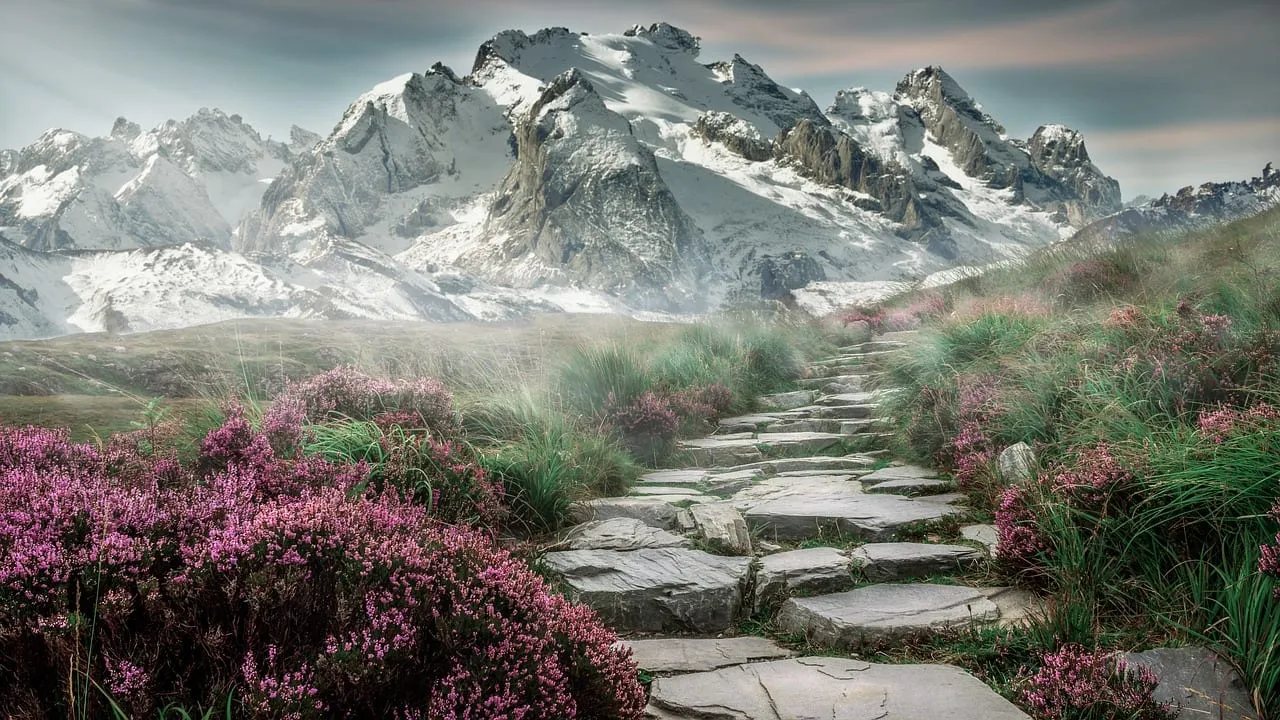
Norway · Trail running
Stoltzekleiven Opp
Stoltzekleiven, Sandviksfjellet, Bergen
A 900 m uphill time trial on the stone staircase from Fjellveien to the saddle below Sandvikspilen above Bergen: about 800 steps and 300 m of climb at an average gradient of 36 %, run one at a time every ten seconds over a Friday and a Saturday in late September. The winners are done in just over eight minutes and the median runner in under seventeen, so this is not a long day out; the challenge is holding a hard effort up a wall that gets steeper the higher you go. It is Bergen's biggest sporting ritual: 6,100 on the start list and 5,100 finishers in 2026, most of them in company and workplace groups, and the places go in minutes.
Official site (opens in a new tab)Joint no. 40 of 41 in the toughness ranking
The race in brief
- Distance
- 0.9 km
- Climb
- 300 m
- Format
- Individual time trial up a stone staircase, one starter every 10 seconds from 09:15 to 18:00 on Friday and Saturday; a separate seeded group for the fastest
- When
- Friday and Saturday in the last week of September (25–26 September 2026; the 2027 dates were not yet announced in October 2026)
- Mid-pack time
- 16 min 46 s (median of all 5,107 finishers, 2026); men 16:06, women 18:25
- Cut-off
- No cut-off; the last start is at 18:00 each day and the slowest finishers take just under an hour
- Entry fee
- 495 kr (Adults, with a 40 kr federation licence included; 235 kr for runners aged 17 or under; the organiser's fee page was last updated in April 2025 and gives no 2027 price yet)
- Field
- 6,131 on the start list and 5,107 finishers, 3,607 men and 1,500 women (2026)
- First held
- 1979
- Other distances
- One course only; a family day with its own entry is held the weekend before
- Organiser
- IL Varegg
Next edition: 2026-09-25 · Groups could enter from 07:00 on 20 May and took over 3,000 places in under a minute; individual entry opened 27 May (seeded and 10-time veterans) and 28 May (everyone else); 33 places were still free on 14 September after the organiser recycled unused numbers · Entries (opens in a new tab)
Checked 2026-10-15
How tough is it?
Four meters, each 1 to 5, rated by our published method. The basis under each one shows the figures behind the score. How we rate.
Median finishing time 16 min 46 s across all 5,107 finishers in the organiser's 2026 result lists (men 16:06, women 18:25; quartiles 14:07 and 18:40 for men). Winners 8:10 and 10:08; the slowest finishers around 50 to 56 minutes (stoltzen.no results, 2026-09). As of 2026-09.
A built stone staircase of roughly 800 steps with 100 wooden steps near the top: about 840 m horizontal, 300 m of climb, gradient between 20 and 40 %, average 35.8 % (organiser's course profile, read 2026-10). Not technical, but wet stone and a gradient that steepens after halfway; the flat is a single short breather before the wooden stairs. As of 2026-09.
Late September in Bergen, the wettest city in Norway: Yr normals for the Florida station give a monthly mean of 12.6 °C and 248 mm of rain in September (read 2026-10). The 2026 edition ran in what the organiser called demanding conditions. Runners start in little and send warm clothes to the top in the organiser's bags; no clothing rule. As of 2026-09.
No cut-offs and no qualifying standard to enter, but entry is the hard part: groups took over 3,000 places in under a minute on 20 May 2026 and the 2025 individual places went three minutes after opening (organiser news, 2026-05 and 2025-06). Entry needs a Stoltze-ID in the organiser's runner database and payment within a day. Of 6,131 on the 2026 start list, 5,107 finished (stoltzen.no, 2026-09). As of 2026-09.
The course
The start is on Fjellveien, the road that runs along the hillside above Bergen's Sandviken district, 200 m south of the BKK transformer station. The clock starts as you cross the line under the Stoltzekleiven sign, and the first stretch winds gently between tall pines, which is where first-timers go out too fast: you cannot see what is coming. The first split is at about 270 m, where the real stone steps begin, and the second at the halfway birch, 495 m in and 145 m up.
From halfway the stairs get steeper with every section, 20 to 40 % and 36 % on average. The only rest is a short flatter stretch before the 100 wooden steps that make up the final wall, where the third split is taken and where the best finishers are measured for the fastest closing stage. The 2026 winners ran 8:10 and 10:08; a median man takes about 16 minutes and a median woman about 18, and the queue of runners above and below you is part of the experience.
The finish is in the saddle below the Sandvikspilen weathervane at about 315 m above the city, with the view back over the harbour. You get a slip with your splits and total time, the finisher T-shirt, water, bananas and hot blackcurrant toddy, and the clothes you handed in at the start are waiting by the road where the scouts keep a fire. Timing is by chip on the bib with manual backup, and results with splits are published on stoltzen.no and EQ Timing the same day.
How to enter
Entry opens in late May in three rounds, all at 07:00 Norwegian time and all first come, first served: groups (companies, clubs, friends) first, a week later individual runners with ten or more previous finishes and those qualified for the seeded group (under 11:00 for men, 13:00 for women in the last three years), and the following morning everyone else. In 2026 the group round sold over 3,000 places in under a minute; in 2025 the individual places were gone three minutes after opening. Every runner needs a Stoltze-ID in the organiser's database, so register that before the day. Unused group numbers are reclaimed after 31 August and recycled, and the organiser says places open up through September; in 2026 there were still 33 free on 14 September, so a late email to the organiser can work.
The fee on the organiser's page is 495 kr (about €42) for adults and 235 kr for runners aged 17 or under, including the Norwegian Athletics Federation single-event licence (40 kr) and the T-shirt; the page was last updated in April 2025, so expect a small rise. Pay by the KID reference within one day (seven days for groups) or the place is deleted. Fees are not refunded, even if the race is cancelled for weather; name changes cost 50 kr and must be done by the organiser after mid-September, and running on someone else's number gets you removed from the results. You choose your day and start slot when you buy; the youngest class is 10 to 11, timed but not ranked.
How to train for it
Train on stairs, not hills
The course is 800 stone steps at 36 %, so the specific session is stair repeats: find the longest staircase or steepest hill path you have and do 2 to 4 minute efforts up it with a walk down. In Bergen people train on the course itself; the organiser's SMS training log on the home page shows regulars climbing it several times a week.
Learn to go out slowly
The first 270 m between the pines is the easiest part and the race's old trap: the organiser's history page notes that the course hides what comes next and many have been fooled. The splits of good runners show the opening section taking under a fifth of their time; aim to arrive at the halfway birch feeling like you could speed up.
Practise the final wooden stairs tired
The last 100 wooden steps come after the steepest stone sections and decide the closing split. Finish your stair sessions with the hardest minute, and rehearse using the handrail and a short, quick step rather than lunging two steps at a time once your legs are heavy.
Use the split calculator
Stoltzen.no has a split-time calculator and a 3D replay of past editions. Put in a target time and it gives you the pace at each of the three splits, which lets you check at the halfway birch whether you are on plan or have gone off too hard.
Pick your start slot with the weather and the crowds in mind
Starts run every ten seconds from 09:15 to 18:00 on both days, and the staircase is busy. An early slot on Friday means fewer runners to pass and usually fresher legs for the stairs after a work week; Saturday afternoon is the party, with the seeded group and prize-giving on the top around 13:45.
What you need
- Shoes with good grip on wet stone; the steps are polished rock and often wet, and the organiser's shoe sponsor sells trail shoes at bib pick-up for a reason
- Race in a vest or T-shirt even in September; you will be working hard for 10 to 20 minutes and it is 300 m to the top
- A bag of warm, dry clothes handed in at the clothes transport north of the start at least 20 to 30 minutes before your slot; it is windy and cool on the saddle and the walk down takes a while
- Your bib with the timing strip left intact, collected at Varegg Arena in the week before the race or on the day
- A rain jacket for the walk down and the wait; September is Bergen's wettest month
Getting there and staying
Bergen Airport Flesland has direct flights from most of Europe; the Bybanen light rail runs to the city centre in about 45 minutes. The race headquarters is Varegg Arena in Sandviken, reached by city bus 10, which stops about 100 m away, and with its own parking. Bib pick-up is there on the Wednesday and Thursday evenings and from 08:15 on both race days, with a pop-up shop from the organiser's shoe sponsor. From the arena it is about ten minutes on foot to the start on Fjellveien, so arrive early if you collect your bib on the day.
Hand in your warm clothes at the clothes transport just north of the start by the BKK transformer station at least 20 minutes before your start; they are carried to the top. After the finish you walk down, either back down the stairs on the side or along the paths over Sandviksfjellet and Fløyen, and the organiser's partner hotel in the centre hosts the AfterStoltz evening on the Saturday. Bergen hotels are busy on this weekend; many participants are locals, so a day trip from a city hotel works, and the family day the weekend before has its own entry for those with children under ten.
History
Stoltzekleiven is a 1930s stone path built as relief work for unemployed young men on the line of an old track called Rævaskaret, named after the merchant Gerhard Stoltz of the nearby Stoltzegården. Varegg's runners had timed themselves up it for decades when the club organised the first race in 1979 for the centenary of Fjellveien, with 50 starters. In 1986, with the club close to dropping the race, NRK's Norge Rundt filmed it and it became known nationally; by 2002 there were 2,368 entered and today more than 6,000.
The men's record of 8:13 set by Jon Tvedt in 1995 stood for over twenty years on the old line and is kept as a protected record, as is Anita Håkenstad Evertsen's 9:56 for women; on the current course the records are 7:46 by Stian Øvergaard Aarvik (2019) and 9:35 by Kristin Størmer Steira (2013), with 10,000 kr on offer from a sponsor for beating them. The 2026 winners were Per-Christian Grieg in 8:10 and Karoline Holsen Kyte in 10:08. The race also has a Plus 90 kg class with over 200 starters, and Bergen triathlete Gustav Iden ran it a dozen times from the age of ten.
Where to find out more
- Stoltzekleiven Opp, official site (opens in a new tab): The organiser's site (http only) with entry information, course profile, results back to 1979, photos and the split-time calculator; Norwegian only.
- Entry information 2026 (opens in a new tab): The dates and the three entry rounds for the latest edition; the 2027 version appears here in spring.
- Results 2026 (opens in a new tab): Class, club and full lists with splits for all 5,107 finishers.
- Live results on EQ Timing (opens in a new tab): The timing company's live page for the 2026 race, with the same results in a searchable form.
- IL Varegg (opens in a new tab): The Bergen multi-sport club that owns and runs the race; its runners train on the stairs year round.
Questions about Stoltzekleiven Opp
How long does it take?
The 2026 median was 16 min 46 s across 5,107 finishers: 16:06 for men and 18:25 for women. The winners ran 8:10 and 10:08 and the slowest finishers took around 50 minutes. Walking all of it is allowed and takes about half an hour.
How do I get a place?
Be online at 07:00 Norwegian time when your round opens in late May: groups first, then runners with ten finishes or a seeded time, then everyone else the next morning. The group round sold over 3,000 places in under a minute in 2026. Create your Stoltze-ID in the runner database beforehand, and email the organiser in September for recycled places if you miss out.
Is it a mass start?
No. Everyone starts individually at ten-second intervals in a slot they chose when entering, from 09:15 to 18:00 on both the Friday and the Saturday. Only the seeded group of the fastest (under 11:00 for men, 13:00 for women) races together on the Saturday, with the prize-giving on the top at about 13:45.
What does it cost and what is included?
495 kr for adults and 235 kr for under-18s on the organiser's fee page (last updated April 2025), including the 40 kr single-event athletics licence and the finisher T-shirt. Payment is due within a day of entering and nothing is refunded.
What is at the top, and how do I get down?
Your time slip, the T-shirt, water, bananas and hot blackcurrant toddy, plus the clothes you handed in at the start. You walk down: either beside the stairs or along the hill paths over Sandviksfjellet and Fløyen into the city.
Can children run?
From the year they turn 10. The 10 to 11 class is timed but not ranked under Norwegian children's sport rules, and the organiser asks that younger children are not sent up the crowded stairs; the family day the weekend before is for them.
Similar races

Norway · Trail
Tromsø Mountain Challenge
Tromsdalen, Tromsø, Troms
50 kmSaturday and Sunday in the third week of August (21–22 August 2027)
Norway · Trail
Birkebeinerløpet
Birkebeineren Ski Stadium to Håkons Hall, Lillehammer, Innlandet
20.2 kmA Saturday in mid June; 12 June 2027 (29th edition)

Norway · Road
DNB Oslo Maraton
Rådhusplassen, Oslo
42.195 kmThird Saturday of September; 18 September 2027 (12 September 2026)
Sweden · Trail
Lidingöloppet
Lidingö, Stockholm
30 kmLast weekend of September; the 30 km is on the Saturday (25 September 2027)
Sources
Figures and rules on this page come from these pages, read on the dates given. Organisers change dates, fees and rules: check the official site before you enter.
- Stoltzekleiven Opp, home page (opens in a new tab) (read 2026-10-15)
- Informasjon påmelding 2026, stoltzen.no (opens in a new tab) (read 2026-10-15)
- Startkontingent, stoltzen.no (opens in a new tab) (read 2026-10-15)
- Info til individuelle, stoltzen.no (opens in a new tab) (read 2026-10-15)
- Info til grupper, stoltzen.no (opens in a new tab) (read 2026-10-15)
- Løypeprofil, stoltzen.no (opens in a new tab) (read 2026-10-15)
- Trasé og tidtaking, stoltzen.no (opens in a new tab) (read 2026-10-15)
- Historie, stoltzen.no (opens in a new tab) (read 2026-10-15)
- Henting av startnummer 2026, stoltzen.no (opens in a new tab) (read 2026-10-15)
- Parkering, stoltzen.no (opens in a new tab) (read 2026-10-15)
- Tøy til toppen, stoltzen.no (opens in a new tab) (read 2026-10-15)
- Premiering Stoltzekleiven Opp 2026, stoltzen.no (opens in a new tab) (read 2026-10-15)
- Gruppepåmelding fulltegnet (20 May 2026), stoltzen.no (opens in a new tab) (read 2026-10-15)
- Stoltzen 2025 fulltegnet (4 June 2025), stoltzen.no (opens in a new tab) (read 2026-10-15)
- Velkommen til Stoltzen 2026 (14 September 2026), stoltzen.no (opens in a new tab) (read 2026-10-15)
- Grieg og Kyte raskest i Stoltzen 2026, stoltzen.no (opens in a new tab) (read 2026-10-15)
- Resultater 2026, stoltzen.no (opens in a new tab) (read 2026-10-15)
- Komplett resultatliste menn 2026, stoltzen.no (opens in a new tab) (read 2026-10-15)
- Komplett resultatliste kvinner 2026, stoltzen.no (opens in a new tab) (read 2026-10-15)
- Startliste 2026, stoltzen.no (opens in a new tab) (read 2026-10-15)
- Individuell påmelding (runner database), stoltzen.no (opens in a new tab) (read 2026-10-15)
- Stoltzekleiven Opp 2026, EQ Timing (opens in a new tab) (read 2026-10-15)
- Bergen (Florida) weather statistics and normals, Yr (opens in a new tab) (read 2026-10-15)