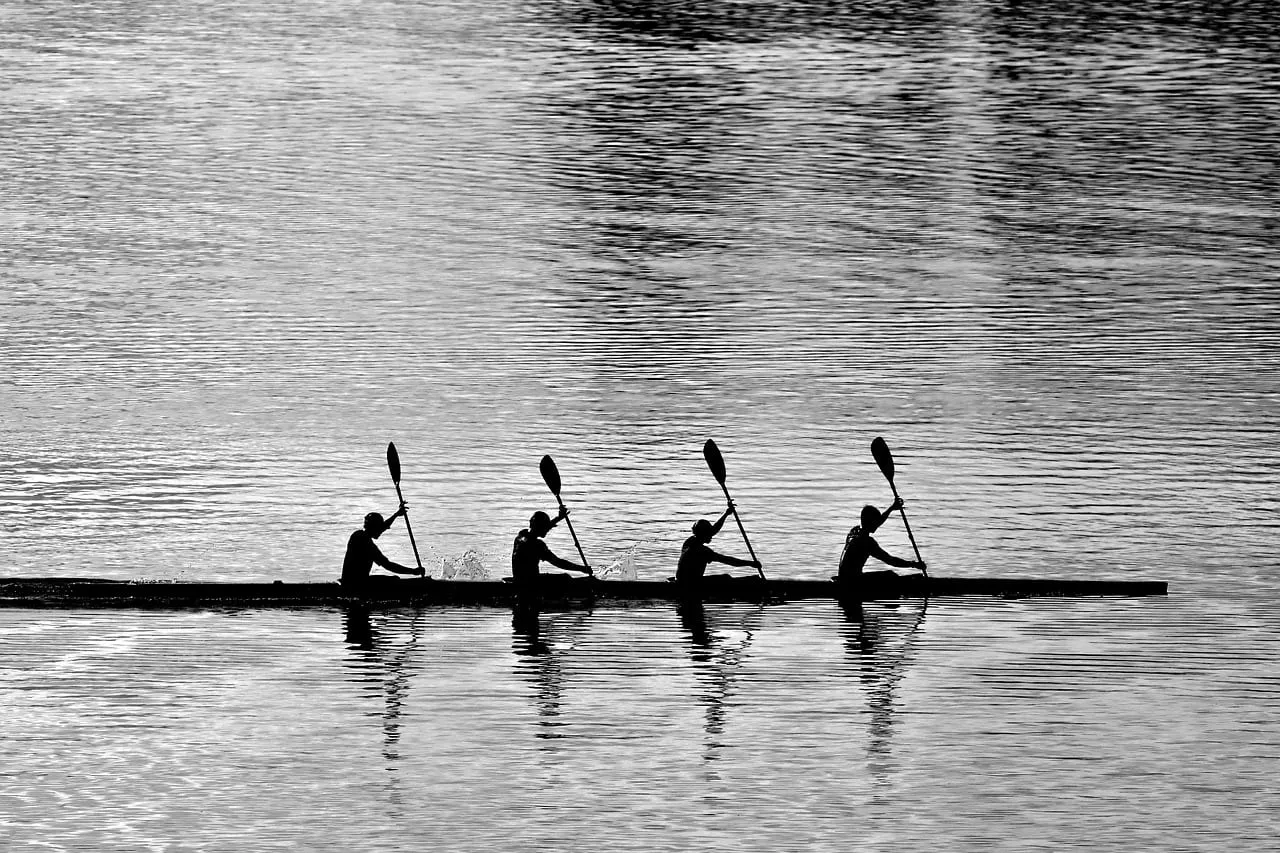
Finland · Multisport and adventure
Sulkavan Suursoudut (Sulkava Rowing Race)
Sulkava, Lake Saimaa, South Savo
Sulkavan Suursoudut is a four-day festival of wooden-boat rowing on Lake Saimaa, held since 1968 in the village of Sulkava in the second week of July. Its heart is the 60 km kuninkuusmatka (the king's distance) around the island of Partalansaari, rowed in 14-oar church boats with a steersman, in single sculls, pairs and other wooden boats, with Finnish championships decided on the Saturday. We rate the church-boat 60 km: a crew of fifteen is out for five to seven hours, there are no cut-offs, and since 2025 you can buy a seat in an organiser's boat without bringing your own crew.
Official site (opens in a new tab)No. 19 of 41 in the toughness ranking
The race in brief
- Distance
- 60 km
- Format
- 60 km anticlockwise around Partalansaari, mass start by boat class from Hakovirta bridge, finish at the Soutustadion in Sulkava; church boats of 14 rowers plus a steersman on Friday afternoon (15:00) and Saturday morning (08:30); single sculls, pairs, sweep pairs and coastal boats on Saturday from 08:40
- When
- Thursday to Sunday in the second week of July (8–11 July 2027)
- Mid-pack time
- 6 h 04 min (median of the 24 church boats in the Saturday day race, 2026); 5 h 14 min for the 51 church boats in the Friday evening race; 6 h 50 min for single sculls
- Cut-off
- No published cut-off; finishers arrive between 11:00 and 18:00 on Saturday and 19:00 to 23:00 on Friday, and the slowest boats in 2026 took 8–10 hours
- Entry fee
- €69–99 (Per rower for the 60 km, 2027: €69 early bird to 31 December 2026, €79 to 28 February, €89 to 31 May, €99 to 4 July 2027. Late entry on site was €100 in 2026. A seat in an organiser-crewed church boat (Soutupiletti) was €129 in 2026; hiring a church boat for the 60 km €550–650)
- Field
- Over 2,000 rowers (organiser's notice, 2026); 2,111 in 2025; 75 church boats and 71 single sculls on the 60 km in 2026
- First held
- 1968
- Other distances
- Kuninkuusmatka 60 km (Friday evening church boats and fours; Saturday church boats, singles, pairs, sweep pairs, coastal and special boats, with Finnish championships) · Retkisoutu 70 km touring row over two days with a night camping at Varviranta (Thursday–Friday or Saturday–Sunday) · Elämysreitit (experience routes) 15 km, 25 km and 35 km (Friday evening and Saturday)
- Organiser
- Tiittala Events Oy with Sulkava-seura ry (the rowing competition)
Next edition: 2027-07-10 · 59th festival, 8–11 July 2027; the 60 km is rowed on Friday 9 and Saturday 10 July. Entries open through Starttiin.fi with the early-bird price until 31 December 2026 and the final price step to 4 July 2027; the organiser was still updating 2027 details in October 2026 · Entries (opens in a new tab)
Checked 2026-10-14
How tough is it?
Four meters, each 1 to 5, rated by our published method. The basis under each one shows the figures behind the score. How we rate.
Official 2026 results (organiser's spreadsheets, 2026-07): the 24 church boats in the Saturday day race took a median 6 h 04 min (open class 5:55, mixed 6:14; fastest 4:47, slowest 8:02); the 51 church boats on Friday evening a median 5 h 14 min (fastest 4:14); the 63 timed single scullers a median 6 h 50 min (fastest 5:32, slowest 9:57). An organiser-crewed novice boat aims for 6 to 6.5 hours. As of 2026-07.
Flat water but open water: 60 km around Partalansaari on Lake Saimaa in a fixed- or sliding-seat wooden boat, mostly in sheltered straits and channels, with two exposed crossings, Haapaselkä at the Keriniemi point and Lepistönselkä, where waves and rocky shallows need boat handling (organiser's route page, 2026). Cargo ships on the deep channel do not give way. Low water in 2026 changed the usual lines. Borderline 4 for the open-water stretches. As of 2026-07.
Second week of July in South Savo. FMI monthly observations for Mikkeli and Punkaharju give July means of 16–20 °C in 2021–2026; on the 2026 race days the daily maximum was 23–27 °C with lows of 10–13 °C, after 8–10 mm of rain on the Thursday. No clothing rule; the organiser warns about sun, chafing and blisters rather than cold. As of 2026-07.
No published cut-offs; finish windows on the timetable run to 18:00 on Saturday and 23:00 on Friday, and 2026 boats took up to 10 hours (results, 2026-07). Entry is open until 4–5 July with late entry on site, no lottery, no sell-out, and no licence except for the Finnish-championship starts. The barrier is practical: a church boat needs 14 rowers and a steersman, or a €129 Soutupiletti seat (sold until 31 May or until the boats are full). As of 2026-07.
The course
Church boats and fours start from under the Hakovirta bridge, 5 km from Sulkava centre, on a shotgun; the first kilometres run with the current through the narrow Hakovirta and Linnanvirta passages below the Linnavuori hill fort, then into the quieter Varmavirta strait. The route goes anticlockwise around Partalansaari, 60 km by the map, and every boat carries a weatherproof route map and a GPS tracker. The first test is Haapaselkä, the open water off the Keriniemi point at the island's south-western corner, where the waves are felt in the hands and rocky shallows have to be rounded with care.
After Haapaselkä the water narrows again into the Kietävälä strait, where the cable ferry gives way to the rowers but the cargo ships on the Saimaa deep channel do not. Half way is Hirviniemi, where an old steamer pier makes a good spectator point, then Jänisselkä and the turn north into Oulunsalmi, where the channel is at times only a few tens of metres wide between small islands. The most famous and hardest stretch follows: Lepistönselkä, a long open crossing that the organiser describes as the test of sisu. The small boats then cut through Leppäsalmi while the church boats stay on the deep channel; the Vekaransalmi bridge marks 10 km to go.
The last turns lead across Kaartilanselkä past Sikoniemi and through Toroppasalmi, with Sulkava church tower in sight, to the finish line on the shore of the Soutustadion. There are two service points on the water: toilets at Käenniemi (about 34 km) and a floating raft at about 50 km with snacks, which you can take alongside without leaving the boat; the touring-row rest stops at Varmavirta, Varviranta and Tölkkäänniemi also have toilets. Safety boats patrol the whole loop, which is split into watch sectors manned by volunteers. The distress signal is an oar held crosswise and moved up and down; if a boat capsizes, stay with it.
How to enter
Entries are made per boat or crew through the Starttiin.fi system used by Finnish rowing and paddling events, with a Suomisport login; you can enter a single, a pair, a four, a 10- or 14-seat church boat, or any unpowered boat in the special-boat class. There is no lottery and the event has never sold out in recent years: online entry runs to 4 July 2027 (5 July in 2026) and late entries are taken at the race office on the day before and on the morning of the race at Hakovirta, at €100 per rower for the 60 km in 2026. Crew lists can be completed later, by mid June, and the system charges for a full crew, so tell the organiser if you row short-handed.
The 2027 price for the 60 km is per rower and rises in four steps: €69 until 31 December 2026, €79 to 28 February, €89 to 31 May and €99 to 4 July 2027. It includes the marked and patrolled route, GPS tracking and results, bag transport from the start and guarded storage, a meal on your rowing day, a wooden finisher's medal and diploma, the service point, saunas, the rowers' lounge at the finish, the shuttle bus to Hakovirta and the evening party. Full-time students get 30 per cent off; under-23s row the small-boat classes of the 60 km and the touring row free. Entries are binding with no refund, but a place can be sold on and the crew change reported to the organiser; the organiser's forum (soutupörssi) is where places and spare rowers are traded.
The Saturday 60 km doubles as the Finnish championship (SM) for wooden boats in every class and age group; to be ranked for medals you need a Suomen Melonta- ja Soutuliitto competition licence and a church-boat steersman with the steersman's course, and SM entries closed on 30 June in 2026. Everyone else rows the same start in the open classes and appears in the overall results. If you have no crew, the Soutupiletti (introduced for 2025) buys one seat in an organiser-crewed 14-seat church boat with an experienced steersman: €129 for the Friday 60 km (target time under 6 hours, with a short practice session before the start), €109 for the 25 km and €149 for the two-day touring row, sold until 31 May or until the boats are full. Church boats can also be hired from the organiser: €550 for a fixed-seat and €650 for a sliding-seat boat for the 60 km in 2026.
How to train for it
Row as a crew before you race as one
Fourteen rowers and a steersman have to find one rhythm for five or six hours. The organiser-crewed boats hold a practice session a few hours before the start; a club crew should have several long outings together, with the stroke pair setting a rate the whole boat can hold on the open stretches of Haapaselkä and Lepistönselkä.
Build up to three hours on a fixed seat
Most church boats are fixed-seat, so the work is in the back, shoulders and arms rather than the legs. Long steady sessions on a rowing machine or in any boat, lengthening towards two or three hours, prepare you for the second half, when the boat gets heavy and the median crew has still an hour or two to go.
Prepare hands and seat
The organiser's own preparation briefing covers blisters and chafing for a reason: 60 km of oar handling and a wooden thwart are what stop people enjoying the last 20 km. Tape or glove up in training, test a seat pad, and use an anti-chafe balm where skin meets wet clothing.
Learn the route and the water level
Crews must study the route map themselves; the organiser runs online briefings in June on the route, the shallows and the service points, and in 2026 warned that low water on Saimaa had changed the usual lines. Practise reading a chart with your steersman and know where the deep channel is, because the cargo ships will not move.
Eat and drink from the first hour
There is one snack raft at 50 km and nothing else, so the boat carries its own food and water for five to seven hours. Crews that have done it talk about rye bread, pickles and sweets passed along the boat; practise eating in the boat on your long rows, and plan a sanitary stop at Käenniemi if you need one.
Train the steersman too
The steersman is legally treated like a motorboat skipper, must be at least 15, and sets the line through the narrow straits and across the open water. The organiser publishes a steersman's basic course and runs a briefing on it; one practised steersman saves more time than a stronger stroke pair.
What you need
- A wooden boat that meets the class rules for competition classes: church boats of wood, maximum 12 m long and 197 cm wide, at most seven pairs of wooden oars and a wooden rudder; small boats of wood, maximum 6.5 m; special-boat and touring classes may use any boat or kayak
- A bailer or pump in every boat (required), and in church boats a red distress flag of 40 by 40 cm on a pole
- The boat number and the organiser's GPS tracker, fitted before the start and returned at the race office for your medal and diploma
- The weatherproof route map handed to each boat; the crew is responsible for knowing the course
- Food and at least a couple of litres of water per rower for five to seven hours; the only service on the water is the snack raft at about 50 km
- Rowing gloves or tape, a seat pad and anti-chafe balm; sun protection and a hat for July on open water
- A change of clothes and swimwear in a bag left at Hakovirta, carried free to the finish lounge; the Lempeä sauna at the finish is mixed and swimwear is compulsory
- Personal accident insurance: every participant is responsible for their own cover (organiser's information pack, 2026)
Getting there and staying
Sulkava is a village in South Savo on Lake Saimaa; it has no railway, so most crews arrive by car with their boat on a trailer, and the organiser points to a car-sharing site and its own forum for lifts. On race day a free non-stop bus runs from Sulkava market square and the school accommodation to the Hakovirta start, 5 km away, from 13:00 on Friday and 07:00 on Saturday, and back until the last spectators have returned; the Hakovirta bridge is closed to traffic during the starts (14:00–16:00 Friday, 08:00–09:30 Saturday in 2026). Church boats are launched at the marked slipways on Alanteentie and trailers parked at the adult education centre; small boats use the Soutustadion slipway at set hours with helpers on hand.
The race office is on the upper terrace of the Soutustadion; the steersman or a rower registers the boat on the day (Saturday crews can do it on Friday, when the office is quietest between 15:00 and 19:00, or at Hakovirta on Saturday morning) and collects the map, wristbands for the meal and the evening programme, the boat number and the GPS unit. Bags left at Hakovirta are carried free to the guarded rowers' lounge at the finish. After the finish there is the Lempeä sauna centre with hot tubs and a swimming jetty beside the lounge, free men's and women's saunas at the sports hall and the municipal offices in the centre, and the rowers' meal at the stadium restaurant (Friday 11:00–23:00, Saturday 12:00–20:00 in 2026). Prize-giving is in stages on the stadium stage, church boats at 17:00 and small boats at 18:00 on Saturday, and the king and queen of the rowing are crowned at 22:15.
Accommodation is thin for a village that hosts thousands: the organiser's page lists manor rooms and a 17-bed barn at Tiittala, large villas for a whole crew, a village hall with 30 beds for one or two church-boat crews, cabins, and a school used as dormitory accommodation on the bus route. Touring rowers camp at Varviranta, a campsite on Partalansaari, with their gear carried there by the organiser. Book months ahead; many crews come back every year to the same beds.
History
The race grew out of the boat builder Kauko Miettinen's boyhood dream of rowing around Partalansaari in one light summer night, an idea the village took up in 1968, when 36 rowers took part. It passed 1,000 in 1980 and peaked at 10,224 rowers in 2003, when it was the largest rowing event in Finland, then fell steadily to 3,400 in 2019 and 1,614 in 2021 after the cancelled 2020 edition. Since 2024 the festival side has been run by an event company based at the Tiittala manor while Sulkava-seura organises the rowing itself, and the organiser's own target is to bring in a new generation that has never rowed a wooden boat.
The patron each year has included four Finnish presidents (Koivisto, Ahtisaari, Halonen and Niinistö). Course records for the 60 km are 3:51:20 for a sliding-seat church boat (2004) and 5:04:50 for a fixed-seat single scull, set in 1991 by the Sulkava legend Ari Kankkunen, whose ten wins in the men's single were passed in 2026 by Heikki Karjaluoto's eleventh. The 70 km touring row with a night at Varviranta has been part of the programme for decades and is the organiser's own favourite for first-timers.
Where to find out more
- Partalansaari 60 km route description (opens in a new tab): The organiser's stretch-by-stretch description of the king's distance, with the route map.
- Prices 2027 (opens in a new tab): Entry fees per distance and date, what is included, and church-boat hire prices.
- Soutupiletti: a seat in an organiser's church boat (opens in a new tab): How to join the 60 km, the 25 km or the two-day touring row without your own crew or boat.
- Competition rules (opens in a new tab): Crew composition, boat specifications for church boats and small boats, drafting and licence rules.
- Results 2026 (opens in a new tab): Friday and Saturday results as spreadsheets, with the GPS tracking service.
- Route records (opens in a new tab): Records for every class on the 60 km since 1991.
- Suomen Melonta- ja Soutuliitto rules (opens in a new tab): The federation's wooden-boat rulebook that governs the Finnish-championship starts.
Questions about Sulkavan Suursoudut (Sulkava Rowing Race)
Can I take part without a crew or a boat?
Yes. The Soutupiletti, introduced for 2025, buys one seat in a 14-seat church boat crewed by the organiser with an experienced steersman: €129 for the Friday 60 km (target under 6 hours), €109 for the 25 km and €149 for the two-day touring row in 2026, including a practice session before the start, meals, sauna and the evening programme. Seats are sold until 31 May or until the boats are full. Crews can also hire a church boat from the organiser.
Is there a time limit?
No cut-off is published. The Saturday timetable shows finishers arriving at the Soutustadion between 11:00 and 18:00 and the Friday evening race between 19:00 and 23:00; in 2026 the slowest church boat took just over 8 hours and the slowest single sculler just under 10, and both are in the results.
Friday or Saturday for the 60 km?
Church boats can row either: Friday's evening race starts at 15:00 and is the faster, bigger field (51 boats, median 5 h 14 min in 2026); Saturday's day race starts at 08:30, carries the Finnish championship, and had 24 church boats with a median of 6 h 04 min in 2026. Singles, pairs, sweep pairs, coastal and special boats row only on Saturday, starting from 08:40.
Do I need a licence?
Only if you want to be ranked in the Finnish championship (SM) classes on Saturday, which need a Suomen Melonta- ja Soutuliitto competition licence for every rower and a qualified steersman, and closed on 30 June in 2026. Everyone else enters the open fitness classes, rows the same course and appears in the overall results (rules, 2026).
What does a church boat crew look like?
Fourteen rowers on seven pairs of oars plus a steersman aged at least 15, who carries the same responsibility as a motorboat driver. The open class has no gender rule, the women's class needs 14 women, and the mixed class allows at most seven men. A 10-seat church boat class also exists for hire. The boat must be wooden, at most 12 m long, and carry a bailer and a red distress flag.
What are the boat classes on the 60 km?
Church boats (open, women, mixed), single sculls (yksinsoutu), double sculls (parisoutu), sweep pairs where one rows and one paddles (vuorosoutu), coastal singles and doubles, special boats of any unpowered type with one to eight people, and on Friday fours (coxed fours and coastal 4x). Small-boat classes have age groups from under 18 to over 70 (programme, 2026).
Similar races
Sweden · Bike
Vätternrundan
Motala, around Lake Vättern (Östergötland, Jönköping and Västra Götaland counties)
315 kmFriday evening to Saturday in mid-June (18-19 June 2027; 12-13 June 2026)
Sweden · Multisport
Åre Extreme Challenge
Tännforsen to Åre, Jämtland (start at the waterfall, finish on Åre beach)
69.7 kmSaturday at the end of June (27 June 2026); the 2027 date is not yet published
Sweden · Swim
Vansbrosimningen
Vansbro, Dalarna (Vanån and Västerdalälven)
3 kmA Saturday in early July (10 July 2027; 4 July 2026), in a swim week of about 10 days
Sources
Figures and rules on this page come from these pages, read on the dates given. Organisers change dates, fees and rules: check the official site before you enter.
- Sulkavan Suursoudut – home page (opens in a new tab) (read 2026-10-14)
- Sulkavan Suursoudut – English home page (59th festival, 8–11 July 2027) (opens in a new tab) (read 2026-10-14)
- Suursoudut 2026 – festival page and news (opens in a new tab) (read 2026-10-14)
- Matkat ja sarjat 2026 (distances, classes, start times) (opens in a new tab) (read 2026-10-14)
- Partalansaari ympäri – 60 kilometrin kuninkuusmatka (route description) (opens in a new tab) (read 2026-10-14)
- Retkisoutu (70 km touring row) and its 2026 timetable (opens in a new tab) (read 2026-10-14)
- Kilpailuaikataulu 2026 (competition timetable) (opens in a new tab) (read 2026-10-14)
- Kilpailusäännöt (competition rules) (opens in a new tab) (read 2026-10-14)
- Hinnasto (prices 2026 and 2027, boat hire) (opens in a new tab) (read 2026-10-14)
- Maksu- ja peruutusehdot (payment and cancellation terms) (opens in a new tab) (read 2026-10-14)
- Ilmoittautuminen (registration instructions, late entry 2026) (opens in a new tab) (read 2026-10-14)
- Osta Soutupiletti (seats in organiser-crewed church boats, 2026) (opens in a new tab) (read 2026-10-14)
- Tulokset 2026 (results page) (opens in a new tab) (read 2026-10-14)
- Saturday 11 July 2026 results (spreadsheet) (opens in a new tab) (read 2026-10-14)
- Friday 10 July 2026 results (spreadsheet) (opens in a new tab) (read 2026-10-14)
- Infopaketti Kuninkuusmatkalle 60 km (rowers' information pack, 2026) (opens in a new tab) (read 2026-10-14)
- Infopaketti Soutupiletin ostaneille (information pack for Soutupiletti rowers, 2026) (opens in a new tab) (read 2026-10-14)
- Liikennejärjestelyt 2026 (traffic and boat-launching arrangements) (opens in a new tab) (read 2026-10-14)
- Kulkeminen (shuttle buses, car sharing) (opens in a new tab) (read 2026-10-14)
- Majoitus (accommodation) (opens in a new tab) (read 2026-10-14)
- Saunat ja peseytyminen (saunas) (opens in a new tab) (read 2026-10-14)
- Valmistautuminen Suursoutuihin (preparation briefings and tips) (opens in a new tab) (read 2026-10-14)
- Opas perähenkilönä toimimiseen (steersman's course) (opens in a new tab) (read 2026-10-14)
- Tiedote Suursoutujen vaikutuksista Sulkavalla (2026 notice: over 2,000 rowers, road closures) (opens in a new tab) (read 2026-10-14)
- Näin seuraat Sulkavan Suursoutuja (spectator guide 2026) (opens in a new tab) (read 2026-10-14)
- Reittiennätykset (route records) (opens in a new tab) (read 2026-10-14)
- Soutajamäärät ja suojelijat (participant numbers 1968–2025 and patrons) (opens in a new tab) (read 2026-10-14)
- Suursoutujen tarina (history) (opens in a new tab) (read 2026-10-14)
- Yle: Sulkavan suursoudut yrittää korjata kävijämääränsä (2023) (opens in a new tab) (read 2026-10-14)
- Yle: Marmeladipallot toivat hopeaa – Sulkavalla soudettiin arvomitaleja (2022) (opens in a new tab) (read 2026-10-14)
- FMI open data – daily observations, Punkaharju, 9–12 July 2026 (opens in a new tab) (read 2026-10-14)
- FMI open data – monthly observations, Mikkeli, 2021–2026 (opens in a new tab) (read 2026-10-14)