Sweden · Gravel and mountain biking
Vätternrundan
Motala, around Lake Vättern (Östergötland, Jönköping and Västra Götaland counties)
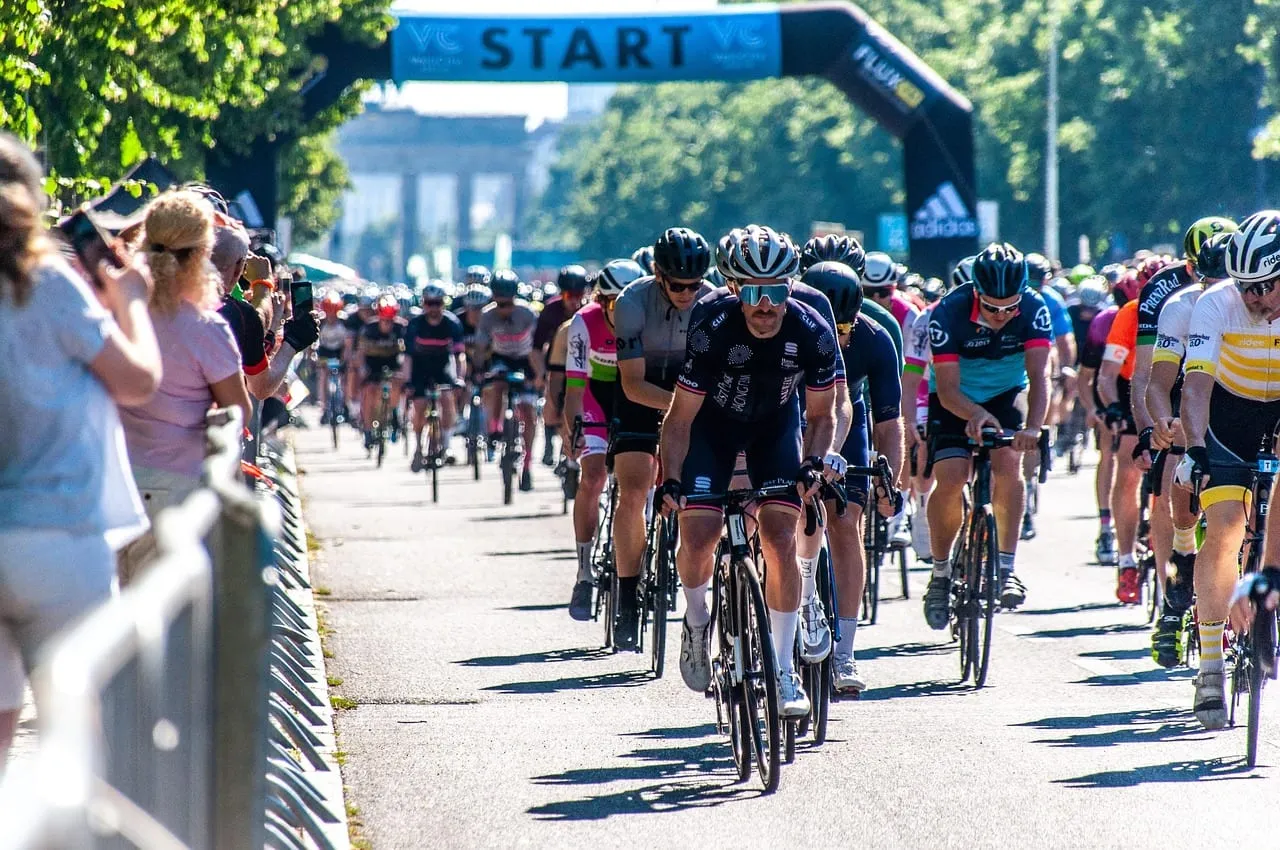
Vätternrundan is a 315 km recreational ride all the way round Lake Vättern, starting and finishing in Motala, and billed as the world's largest recreational cycling event. It is not a race: most people start on Friday evening, ride through the light June night and finish on Saturday. The real picture is a day of roughly 13 hours in the saddle for a mid-pack rider, a finish line that closes at midnight, and about 94 per cent of starters getting there.
Official site (opens in a new tab)No. 9 of 41 in the toughness ranking
The race in brief
- Distance
- 315 km
- Format
- 315 km loop around Lake Vättern on open public roads, start and finish in Motala, timed with a chip but not a race; staggered starts from Friday evening, plus fast SUB 9 groups on Saturday midday
- When
- Friday evening to Saturday in mid-June (18-19 June 2027; 12-13 June 2026)
- Mid-pack time
- About 13 h 15 min (median of a sample of roughly 470 finishers, 2026; the organiser publishes no average)
- Cut-off
- Jönköping depot closes 11:30 and Hjo 16:00 on Saturday, and the finish in Motala closes at 24:00; you must reach a depot 20 minutes before it closes
- Entry fee
- 2 100–2 400 kr (2027 edition; three price periods from 25 November 2026 to 16 June 2027, and 2,400 kr for on-site registration in Motala)
- Field
- 17,192 starters and 16,236 finishers (2026); nearly 20,000 registered
- First held
- 1966
- Other distances
- Vätternrundan 315 km · Halvvättern 150 km · Tjejvättern 100 km · Vätternrundan 100 km · MTB-Vättern · Vätternrundan Gravel · Minivättern
- Organiser
- Vätternrundan (run by the non-profit club Motala AIF)
Next edition: 2027-06-18 · Step 1 (prepare an individual or group registration) runs 17 June to 23 November 2026; step 2, with start times and payment, opens 25 November 2026 at 19:00 CET. Race days 18-19 June 2027, the 62nd edition. · Entries (opens in a new tab)
Checked 2026-10-15
How tough is it?
Four meters, each 1 to 5, rated by our published method. The basis under each one shows the figures behind the score. How we rate.
Median elapsed time about 13 h 15 min (start to finish) in a sample of about 470 finishers drawn from the official 2026 results at result.vatternrundan.se; the middle half took 11 h to 15 h 45 min and the fastest tenth 9 h 30 min or less. The organiser publishes no average, so treat this as an estimate. Well over the 10 h line. As of 2026-06.
Open public roads, tarmac all the way, on rolling lake-shore terrain with a few longer climbs; total climb is not published by the organiser, so this score is a judgement. The difficulty is distance, wind and the night, not technical ground. Disc wheels and triathlon bars are banned, and traffic stays open on the whole route. Borderline 3 for 315 km of back-to-back rolling. As of 2026-06.
Mid-June, much of it overnight. SMHI 1991-2020 gives a June daily mean of about 16 C at Linköping, and nights are cooler; the organiser's own page recalls snow flurries in 1981 and the 2026 ride had rain through the night and morning. Front and rear lights and reflectors are compulsory for starts between 19:30 and 03:00. Cool and wet rather than cold. As of 2026-06.
Three clock cut-offs (Jönköping 11:30, Hjo 16:00, finish 24:00) give a 19:30 starter about 28 h 30 min at most, against a median near 13 h; 94 per cent of 2026 starters finished (16,236 of 17,192). Entry is two-step registration with places released 25 November 2026, and nearly 20,000 registered in 2026. No sell-out time is published, so borderline 3 for the entry race. As of 2026-06.
The course
You start in Motala at Stora Torget. Start slots run from 19:30 on Friday to about 06:30 on Saturday, in groups every few minutes, and you ride the loop in one direction round the lake. The official depots, in order, are Ödeshög (47 km), Ölmstad (83 km), Jönköping (104 km), Fagerhult (133 km), Hjo (171 km), Karlsborg (204 km), Boviken (225 km), Askersund (256 km) and Godegård (284 km), with a self-service water stop at Rödån (143 km). Jönköping at the southern end is the first big milestone and the first cut-off.
The route follows ordinary public roads, so there are junctions, villages, and cars and lorries sharing the road. The organiser asks you to ride no more than two abreast, not to start too fast, and to remember that you will be tired when the traffic is busiest on Saturday morning. The second half is where fatigue shows, because the last depots, Askersund (256 km) and Godegård (284 km), come after more than ten hours for most riders. First-timers are advised to take an early start slot, so that they have calmer roads, more time to the cut-offs and the sunrise over the lake.
Depots offer food and drink, bike service and first aid, and support cars marked Följebil collect riders who stop. Timing is by chip on your helmet, and your start number goes on your chest and handlebars. The finish is in Motala, where riders collect a medal; the six-hour rule applies afterwards, so you must rest for at least six hours before driving, and police check the exits against finish times. If you retire you tell the staff at a depot and are carried back to Motala, where your bike waits at Zederslundsskolan.
How to enter
Entry is in two steps. From 17 June to 23 November 2026 you prepare an individual or group registration and, if you are riding with friends, choose at least three preferred start-time intervals. On 25 November 2026 at 19:00 CET you submit your registration code, receive a start time and pay within five days or the place is cancelled. Young riders can start from the year they turn 15 (it was 18 until 2026); the organiser advises riders aged 15 to 17 to ride with an adult. The organiser publishes no sell-out time for 2027.
The fee for 2027 is 2,100 kr (25 November 2026 to 13 January 2027), 2,200 kr (to 17 March) and 2,300 kr (to 16 June), with 2,400 kr for on-site registration in Motala and 2,300 kr for a pre-booked group. That is roughly 190 to 215 euros. The entry is binding, not refundable and cannot be moved to another year; a place can be transferred to another person for 350 kr in a short window before the race. A start-time change costs 350 kr. The organiser suggests optional Folksam event insurance (155 kr or 275 kr a year) to get the fee back if illness or injury stops you from starting.
SUB 9 groups start on Saturday between 11:30 and about 12:30 for riders aiming to finish under nine hours, around 1,000 places allocated to pre-booked clubs and companies. You do not need a cycling licence or club membership to ride the ordinary 315 km.
How to train for it
Ride a six to eight hour day before you commit
The median finisher is out for about 13 hours, so the key session is one very long ride at conversational pace with the food you will use on the day. If you have never ridden more than 100 km, build through 150 and 200 km rides in spring. The jump from a normal long ride to the second half of Vätternrundan is what catches people out.
Train for the night, not just the distance
A Friday slot means riding through the short June night in the dark with lights compulsory from 19:30 to 03:00. Do at least one long ride that includes riding after dusk and into early morning, with the clothes you will carry, and practise eating and drinking when you are sleepy.
Pace the first 100 km and eat early
Depots are 20 to 50 km apart, so you can eat at every one. Going out too fast in a group on the quiet night roads is a common way to run short of energy late on. Aim for the same effort in the last 100 km as in the first, and fuel from the start.
Learn to ride in a group safely
Roads are open to traffic and the organiser calls overtaking one of the biggest risk factors. Practise holding a wheel at an even speed, riding no more than two abreast, and signalling hazards. Do not attach clip-on bars; they are banned.
Plan for rain and for a cold hour at dawn
The 2026 ride had rain through the night and morning. Train once in wet weather with the exact rain jacket and overshoes you will pack, and carry a light layer for the cooler hour around sunrise, because stopping makes you cold fast.
Choose your start slot for your pace
The organiser advises first-timers to take an early Friday slot, which gives more time before the cut-offs and quieter roads. Clock cut-offs are the same for everyone, so a late Friday or Saturday-morning slot leaves less time to Jönköping and Hjo; be realistic about your speed.
What you need
- EN 1078 approved helmet, worn throughout and visible; the timing chip goes on the helmet above the ear
- Working front and rear lights and approved reflectors for any start between 19:30 and 03:00 (Saturday evening too)
- Start number on your chest and on the handlebars, facing forward
- A two-wheel bicycle only: drop handlebars are recommended, bar-ends must be plugged, triathlon and loose bars and full disc wheels are not allowed, and rims may be at most 65 mm deep at the front and 80 mm at the rear
- Rain jacket and a warm layer for the night and the early morning; June nights can be cool and wet
- Spare tubes or tubeless repair kit, a pump and a multitool; depots have bike service but not between them
- Your own food that you have already tested, in addition to the depots; the organiser also sells a pre-bookable energy package
- No headphones and no phone use while riding; stop off the road if you must use your phone
Getting there and staying
The start and finish are both in Motala, in Östergötland, a small town on Lake Vättern; check rail and air connections for your own route. Bike week, with the shorter races, runs around the weekend, and the expo and bike service are in Motala. There are no private depots or cars allowed on or around the course.
There is always accommodation for everyone during bike week, but the standard and range vary and the organiser says to book well in advance. Bike rental is available through a partner and can be picked up at the event area. Because you finish late at night or the next morning and the six-hour rule bans driving for six hours afterwards, plan a bed or a lift for the night after the finish.
History
The first Vätternrundan was held in 1966, and the 2027 ride will be the 62nd. Early editions had few riders (the organiser notes six women in the 1966 field), and by 2026 more than half of the nearly 20,000 registered riders were first-timers. The organiser records the 1981 ride as a nightmare, with biting cold and snow flurries in June.
Where to find out more
- Vätternrundan 315 km (opens in a new tab): Organiser's race page with fees, start times, cut-offs and the two-step registration.
- Rules (opens in a new tab): Equipment, lights, bike types, age limits and conduct rules for all events.
- Depots (opens in a new tab): Depot names and distances along the 315 km route.
- Results and start lists (opens in a new tab): Searchable results back to 1995; you must enter a name, club or city to get a list.
- Registration terms (opens in a new tab): Binding entry, no refunds, entry transfer, start-time change and insurance.
Questions about Vätternrundan
How long does Vätternrundan take?
From a sample of about 470 finishers in the official 2026 results, the median ride took about 13 h 15 min from the start slot to the line. The fastest tenth took under 9 h 30 min, and the slowest tenth over 17 h 30 min. The finish closes at midnight on Saturday.
What are the cut-off times?
Jönköping depot closes at 11:30 and Hjo at 16:00 on Saturday, and the finish in Motala at 24:00. You must reach a depot 20 minutes before it closes. SUB 9 groups that start at midday have a different, stricter set of depot times.
How many people finish?
In 2026, 17,192 started and 16,236 finished, about 94 per cent. Rain through the night and morning made the ride tougher than usual, according to the organiser.
How much does it cost?
For 2027 the fee is 2,100 kr if you register 25 November 2026 to 13 January 2027, 2,200 kr to 17 March and 2,300 kr to 16 June; on-site registration is 2,400 kr. Roughly 190 to 215 euros. Entries are not refundable or movable to another year.
Can I drive home after finishing?
Not at once. There is a six-hour rule: you must rest at least six hours after finishing before driving from Motala, and the police check the exits against finish times. Plan accommodation or a lift.
Do I need a licence or a special bike?
No licence or club membership is needed. You need a two-wheel bike, an approved helmet and lights for night starts. E-bikes are only allowed in the 100 km event, and triathlon bars and disc wheels are not allowed.
Similar races

Sweden · Bike
Cykelvasan
Sälen (Berga by) to Mora, Dalarna
92 kmSaturday in mid-August (14 August 2027)
Sweden · Trail
Lidingöloppet
Lidingö, Stockholm
30 kmLast weekend of September; the 30 km is on the Saturday (25 September 2027)
Sweden · Ski
Vasaloppet
Sälen (Berga by) to Mora, Dalarna
90 kmFirst Sunday of March (7 March 2027)
Norway · Bike
Birkebeinerrittet
Rena to Lillehammer, Innlandet
84 kmLast Saturday of August; 28 August 2027
Norway · Bike
Styrkeprøven
Trondheim to Oslo (also Lillehammer, Eidsvoll to Oslo)
515 kmThird weekend in June; organiser lists 18 to 20 June 2027, with the ride on the Saturday (19 June) as in earlier years
Sources
Figures and rules on this page come from these pages, read on the dates given. Organisers change dates, fees and rules: check the official site before you enter.
- Vätternrundan 315 km (race page, fees, cut-offs, start times) (opens in a new tab) (read 2026-10-15)
- Vätternrundan - About registration (terms, transfer, insurance) (opens in a new tab) (read 2026-10-15)
- Vätternrundan - Rules (opens in a new tab) (read 2026-10-15)
- Vätternrundan - Depots (opens in a new tab) (read 2026-10-15)
- Vätternrundan - Cut-off times (opens in a new tab) (read 2026-10-15)
- Vätternrundan - Abandoning the ride (opens in a new tab) (read 2026-10-15)
- Vätternrundan - SUB 9 (opens in a new tab) (read 2026-10-15)
- Vätternrundan - Six-hour rule (opens in a new tab) (read 2026-10-15)
- Press release: 16 236 fullföljde Vätternrundan (14 June 2026) (opens in a new tab) (read 2026-10-15)
- Så var Vätternrundan 315 km 2026 (16 June 2026) (opens in a new tab) (read 2026-10-15)
- Vätternrundan results archive 2026 (sample of 315 km finishers) (opens in a new tab) (read 2026-10-15)