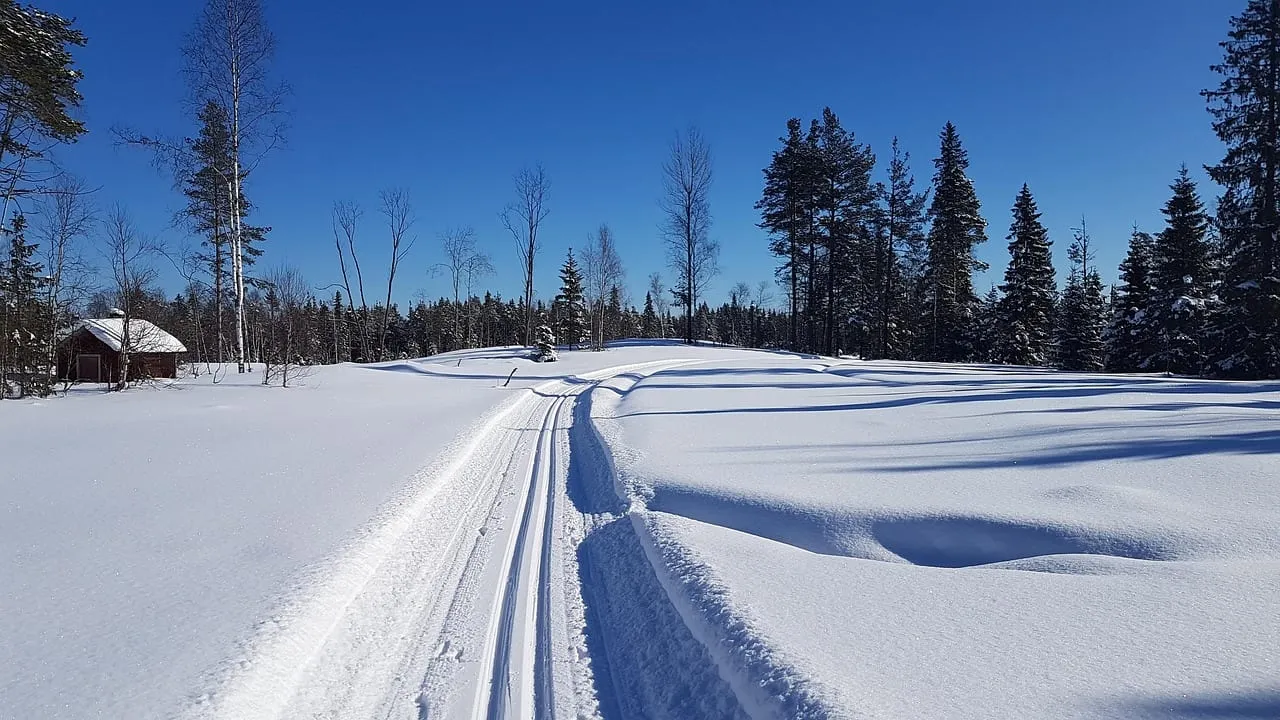
Sweden · Cross-country skiing
Vasaloppet
Sälen (Berga by) to Mora, Dalarna
Vasaloppet is the world's biggest cross-country ski race: 90 km of classic technique from Berga by in Sälen to the finish portal by the belfry in Mora, held on the first Sunday of March since 1948 and first run in 1922. Around 14,000 people enter the main race; most are recreational skiers who train through the winter for one long day on groomed tracks. The real picture: about eight hours for a mid-pack skier, a 12-hour limit with seven cut-offs along the way, and in a hard year like 2026 (10-20 cm of fresh snow) one in five starters did not reach Mora.
Official site (opens in a new tab)No. 16 of 41 in the toughness ranking
The race in brief
- Distance
- 90 km
- Format
- 90 km point to point, classic technique only, joint start at 08:00 in an elite group plus ten seeded start groups
- When
- First Sunday of March (7 March 2027)
- Mid-pack time
- 7 h 58 min (median finisher, 2026, a slow year with fresh snow); winners around 4 h 15 min
- Cut-off
- Seven checkpoints with cut-offs: Smågan 11:00, Mångsbodarna 12:15, Risberg 13:45, Evertsberg 15:00, Oxberg 16:30, Hökberg 17:40, Eldris 19:00; about 12 hours in total
- Entry fee
- 2 460–2 985 kr (2027 edition; five price periods from 19 Feb 2026 to race week)
- Field
- 14,300 registered and 10,395 finishers (2026); cap 15,800
- First held
- 1922
- Other distances
- Öppet Spår Sunday 90 km (classic, untimed cut-offs) · Öppet Spår Monday 90, 45 and 30 km (freestyle) · Vasaloppet 45 (Oxberg to Mora) · Vasaloppet 30 and Tjejvasan 30 km · Nattvasan 90, 45 and 30 km (night, freestyle) · Stafettvasan relay · Vasaloppet 10
- Organiser
- Vasaloppet (Vasaloppsföreningen Sälen-Mora, the clubs IFK Mora and Sälens IF)
Next edition: 2027-03-07 · Opened 16 February 2026 for priority entrants and 19 February 2026 for everyone; still open on 14 October 2026, fee rising in steps; the race is capped at 15,800 · Entries (opens in a new tab)
Checked 2026-10-14
How tough is it?
Four meters, each 1 to 5, rated by our published method. The basis under each one shows the figures behind the score. How we rate.
Median finishing time 7 h 58 min: finisher 5,198 of 10,395 in the official results list sorted by time (results.vasaloppet.se, 2026-03). Winners 4 h 14 min (men) and 4 h 24 min (women); the last finishers 13 h 23 min after cut-offs were extended. The organiser says 2026 was about an hour slower than usual, so a normal year's median is nearer 7 h, still well inside the 5-10 h band. As of 2026-03.
Groomed classic track for 90 km, point to point. The only big climb is in the first 3 km: 178 m up to the course's highest point at 528 m (organiser's facts, 2026-02); then long flat marshes to Mångsbodarna, a climb to Risberg, the hill prize at Evertsberg (47 km) and Lundbäck's hill before Oxberg, then rolling forest and a long flat run into Mora. No technical skiing, but a prepared track over 90 km with crowding in the early kilometres. As of 2026-03.
Early March in inland Dalarna with a start at 08:00. The organiser says the start temperature in Sälen has been above freezing only a few times since 2000 (news, 2025-11); in 2018 it was about -7 C at the start after -25 C earlier in the week (The Local, 2018-03). Skiers are out 6-12 hours and the marshes are open to wind. No clothing rule, but the organiser warned that visitors from southern Sweden were underdressed. As of 2026-03.
Seven cut-offs on a roughly 12-hour schedule (Smågan 11:00 to Eldris 19:00) against a median of about 8 h; in 2026 78 per cent of starters finished and about half of the non-finishers missed a cut-off (organiser, 2026-03); normal years are kinder. Entry is first come, cap 15,800: 2026 still had places in late February and 2027 was open in October, so no lottery. Seeding decides your start group; without a 40 km seeding race you start at the back. As of 2026-03.
The course
You start on a field at Berga by in Sälen, a kilometre long and about 50 tracks wide, at 08:00 with the whole field at once. The first 3 km climb about 178 m on a forest road to the highest point of the course, 528 m above sea level, and this is where the race is slowest: the tracks narrow, the back groups queue, and many people herringbone with skis off the track. From the top the course drops onto the long marshes before Smågan (11 km), the first checkpoint, which has had a rerouted final kilometre since 2026 to avoid water crossings. The next 10 km to Mångsbodarna (24 km) wind over hilly forest trail and footbridges over the mires.
After Mångsbodarna the course descends to a cold hollow at Tennäng before a drawn-out climb of several kilometres up to Risberg (36 km), followed by a fast downhill and a false plateau to Evertsberg (47 km), where the hill prize is decided. Evertsberg is roughly halfway in time for most people, and in a normal year it is where most of the withdrawals happen; in 2026 more than half dropped out before it because the fresh snow made the first half so heavy. From Evertsberg the track goes mostly downhill to Oxberg (62 km), with Lundbäck's hill, a 50 m climb just before the checkpoint where several races have been decided.
Between Oxberg and Hökberg (71 km) the track rolls, then flattens out past Eldris (81 km) into Mora. The last kilometres run along the Vasaloppet track to Mora ski stadium at Hemus, rerouted in 2026 to approach the stadium straight through more undulating terrain, and then through the town to the finish portal with its motto 'I fäders spår för framtids segrar'. Timing is by chip at every checkpoint; all seven serve drink and energy (blueberry soup is the tradition), offer grip-wax help and small repairs, and have toilets and medical staff. Finishers get a medal, drinks and refreshments at the line; skiers within the winning time plus 50 per cent (6 h 22 min for men and 6 h 37 min for women in 2026) also get the achievement medal.
How to enter
Entries for the 103rd Vasaloppet (7 March 2027) opened on 16 February 2026 for people with priority access and on 19 February 2026 for everyone, straight after the 2026 race. The main race is capped at 15,800 and fills on a first-come basis, with no lottery or qualifying time; it does not sell out on the day. In 2026 there were still places in late February, and on 14 October 2026 the 2027 race was still open. Tjejvasan and Öppet Spår Sunday tend to fill first.
The 2027 fee rises in five steps: 2,460 kr (19 February to 27 March 2026), 2,635 kr (to 10 September), 2,685 kr (to 5 November), 2,735 kr (to 24 February 2027) and 2,985 kr in race week. That is roughly 215 to 260 euros. The fee covers the bib and chip, checkpoint service, bag transport from the start to Mora, the finisher medal and the diploma; the bus to the start costs extra (booking opens at the end of November). You can enter from the year you turn 17; there are two classes, women and men.
Entries are binding with no refund and no deferral to the next year (general terms, 2024). If the race is cancelled for lack of snow or extreme cold, 50 per cent is refunded under the Swedish Ski Association's guidelines. You can hand your place to another person under the organiser's transfer rules. No licence or club membership is needed for ordinary skiers; only the competition class (the elite group) needs a FIS code and, for Swedes, a club affiliated to the Swedish Ski Association. Fluorinated wax is banned in all Vasaloppet ski races since 2024.
Your start group matters more than your entry date. Without a prior result you start in Group 10 at the back and spend the first climb in a queue. Any seeding race of 40 km or more, including Öppet Spår, Vasaloppet 45 or certain roller-ski races, lifts you to Group 9 or better; results count for three years but drop one group a year. Foreign results are accepted if you send them to the organiser with your Vasa ID.
How to train for it
Build hours, not speed
A mid-pack skier is on the course for seven to nine hours. The thing that decides your day is whether you can keep double-poling and diagonal striding after five hours, so long easy sessions of three hours and more on skis or roller skis matter more than intervals. If you live without snow, roller-ski or ski-walk with poles on hilly roads.
Double-pole the flats
From the top of the first hill to Mångsbodarna, and again from Eldris to Mora, the track is close to flat and most people double-pole for an hour at a time. Train it specifically: long blocks of double-poling on roller skis, plus upper-body strength through the autumn.
Prepare for the first hill
The 178 m climb in the first 3 km is done at a walk in the rear groups and you can lose 20 or 30 minutes queueing. Do not fight it: it is the same for everyone around you. A seeding race in the season before moves you forward and shortens that queue.
Practise the long drag to Risberg
The climb from Tennäng up to Risberg is several kilometres of steady uphill at 30-36 km, long after the start adrenaline is gone, and it is where many first-timers first feel the distance. Train long uphill striding when tired, and plan to eat before it, not during it.
Eat at every checkpoint
Seven checkpoints serve drink and energy and blueberry soup; the gap from the start to Smågan is 11 km and the longest gaps are 12-15 km. People who skip stations early tend to fade after Evertsberg. Practise eating on the move and carry something of your own for the first 11 km.
Respect the cut-off schedule
The checkpoint limits (Smågan 11:00 to Eldris 19:00) sit around 10-11 hours of skiing. In 2026 about one in ten starters was stopped at a cut-off. If your long training sessions suggest you are a 10-hour skier, Öppet Spår, which has more relaxed timing, may be the better race.
What you need
- Classic skis with grip wax or skin skis; skating and repeated track changes are not allowed and can lead to disqualification
- No fluorinated wax or top coats of any kind (banned since 2024, checked at the start)
- Bib worn visibly and the timing chip, collected in Sälen or Mora; both are needed to enter your start group
- A dry change of clothes in a bag for the official lorry to Mora; you hand it in at the start and collect it at Mora gymnasium after the finish
- A wind-proof layer for the open marshes and the 05:00-08:00 wait in the start pen, usually well below freezing
- Warm clothes and a hat to wear until the start; many leave an old jacket in the pen
- Your own gel or bar for the first 11 km and a small bottle; the checkpoints cover the rest
- Spare pole basket and a strip of tape; checkpoints do minor repairs but not everything
Getting there and staying
The start is in Sälen and the finish 90 km away in Mora, so plan for a point-to-point day. Mora has a railway station and is the base most people use. The organiser runs official buses to the start and back from the finish and asks everyone to use them rather than drive; booking opens at the end of November. Buses leave early because you must be in your start group by 07:45 (pens open at 05:00 for Group 10 and 05:30 for Groups 1-9).
Vasaloppet does not arrange accommodation and refers people to Visit Dalarna and the Sälen ski resort for hotels, cabins and camping; beds in Mora and Sälen go early for race week, so book months ahead. Bibs are collected at the race office in Sälen or on Kyrkogatan in Mora in the days before; uncollected kits are at the start office on race morning. Your bag goes on a numbered lorry at the start. After the finish you leave your skis in the ski deposit, take the free bus to the showers at Prästholmens IP and to Mora gymnasium where your bag is, and come back for the diploma.
If you stop, tell the medical staff or an official at the nearest checkpoint; they take care of the chip and arrange a bus to Mora. In 2026 many stopped early and the buses were stretched, which the organiser is reviewing for 2027. Race week 2027 coincides with the Nordic World Ski Championships in Falun, also in Dalarna, so expect the region to be busier than usual.
History
The race follows the route of Gustav Eriksson Vasa's flight from the Danish king's soldiers in the winter of 1520-21; the men of Mora sent two skiers after him and caught him in Sälen, after which he returned to lead the uprising and became king. The newspaper editor Anders Pers proposed a commemorative race in February 1922, IFK Mora organised it within weeks with 1,000 crowns from Dagens Nyheter, and 119 skiers started on 19 March 1922. Ernst Alm of Norsjö IF won in 7 h 32 min in sleet and snow.
Margit Nordin skied the race in 1923, after which the board voted to ban women for decades; a women's competition class came in 1997. The race was cancelled in 1932 and 1934 (lack of snow and of entries) and in 1990; the course moved off the roads in the late 1930s. Nils 'Mora-Nisse' Karlsson won nine times from 1943, and since 1948 the race has been on the first Sunday of March (except 2015). In 2026 the two-millionth finisher across all Vasaloppet events crossed the line in Mora, and 649,201 skiers had finished the 90 km race over its first 101 editions.
Where to find out more
- Vasaloppet race page (opens in a new tab): Organiser's page with fees, cut-off times, checkpoint service, start procedure and bus booking.
- Seeding for Vasaloppet (opens in a new tab): How the eleven start groups are assigned and which races count as seeding races.
- Official results (opens in a new tab): Results and start lists for every Vasaloppet event back to 1922, with live tracking on race day.
- Rules and insurance (opens in a new tab): Technique rules, the fluor ban, littering penalties and what insurance applies in an accident.
- General terms and conditions (opens in a new tab): Binding entry, no refunds, the 50 per cent refund if the race is cancelled for snow or cold, and place transfers.
Questions about Vasaloppet
How long does Vasaloppet take for an ordinary skier?
In 2026 the median finisher took 7 h 58 min and the finish line stayed open past 13 hours; the organiser said that year was about an hour slower than usual because of fresh snow. Winners finish in just over four hours. Plan for seven to ten hours if you are fit but new to long-distance skiing.
Do I need to qualify or win a lottery?
No. Entry is first come, first served up to the cap of 15,800, and the 2027 race (7 March 2027) was still open in October 2026. Seeding only affects your start group: with no prior result you start in Group 10, and a 40 km seeding race moves you up.
What are the cut-off times?
Seven checkpoints close in turn: Smågan 11:00, Mångsbodarna 12:15, Risberg 13:45, Evertsberg 15:00, Oxberg 16:30, Hökberg 17:40 and Eldris 19:00, giving about 12 hours from the 08:00 start. You must leave a checkpoint within ten minutes of its limit, and if you miss one you are bussed to Mora. Race directors can change the limits in extreme weather, as they did in 2026.
How much does it cost to enter?
For 2027 the fee is 2,460 kr if you entered by 27 March 2026, rising through 2,635, 2,685 and 2,735 kr to 2,985 kr in race week (about 215-260 euros). Entries are not refundable and cannot be moved to a later year; a 50 per cent refund applies only if the race is cancelled for lack of snow or extreme cold.
Can I skate or use any wax?
No. Vasaloppet is classic technique only under FIS rules; skating or repeated track changes can get you disqualified, and recreational skiers get verbal warnings first. All fluorinated wax and top coats have been banned in Vasaloppet's ski races since 2024.
Is there an easier way to ski the 90 km?
Öppet Spår is the same course on the Sunday and Monday before Vasaloppet with the same checkpoints; the Monday race is freestyle so you can skate. Vasaloppet 45 starts in Oxberg and covers the second half, and Vasaloppet 30 and Tjejvasan the last 30 km from Oxberg.
Similar races
Norway · Ski
Birkebeinerrennet
Rena to Lillehammer, Innlandet
53 kmA Saturday in mid March; 20 March 2027 (87th edition)
Finland · Ski
Finlandia-hiihto
Lahti Sports Centre, Lahti and Hollola, Päijät-Häme
62 kmThird or fourth weekend of February; 20–21 February 2027
Iceland · Ski
Fossavatnsgangan
Seljalandsdalur above Ísafjörður, Westfjords
50 kmThe last Saturday of the Icelandic winter, mid April: 18 April 2026, 17 April 2027, 8 April 2028, 14 April 2029

Sweden · Bike
Cykelvasan
Sälen (Berga by) to Mora, Dalarna
92 kmSaturday in mid-August (14 August 2027)
Sources
Figures and rules on this page come from these pages, read on the dates given. Organisers change dates, fees and rules: check the official site before you enter.
- Vasaloppet - race page (fees 2027, start, checkpoints, cut-offs) (opens in a new tab) (read 2026-10-14)
- Vasaloppet - Rules (opens in a new tab) (read 2026-10-14)
- Vasaloppet - General terms and conditions (opens in a new tab) (read 2026-10-14)
- Vasaloppet - Seeding Vasaloppet (opens in a new tab) (read 2026-10-14)
- Vasaloppet results 2026 - Vasaloppet finisher list sorted by time (opens in a new tab) (read 2026-10-14)
- Vasaloppet recaps the Winter Week 2026 and looks ahead with confidence (24 March 2026) (opens in a new tab) (read 2026-10-14)
- Facts, statistics, news and trivia ahead of Vasaloppet 2026 (26 February 2026) (opens in a new tab) (read 2026-10-14)
- Fantastic achievements from Vasaloppet's Winter Week 2026 (10 March 2026) (opens in a new tab) (read 2026-10-14)
- Strong interest in Vasaloppet's Winter Week 2026 - and Vasaloppet is getting a new route (19 November 2025) (opens in a new tab) (read 2026-10-14)
- Some news ahead of Vasaloppet's Winter Week 2026 (17 December 2025) (opens in a new tab) (read 2026-10-14)
- The Vasaloppet Year 2026: Nearly 90,000 Participants (11 September 2026) (opens in a new tab) (read 2026-10-14)
- Vasaloppet - History: The first Vasaloppet (opens in a new tab) (read 2026-10-14)
- Vasaloppet - History: Vasaloppet's development (opens in a new tab) (read 2026-10-14)
- Vasaloppet - History: Start and finish (opens in a new tab) (read 2026-10-14)
- Vasaloppet - Boende (accommodation guide, Swedish) (opens in a new tab) (read 2026-10-14)
- The Local: Relief for Sweden's Vasaloppet race as air warms to -7C (4 March 2018) (opens in a new tab) (read 2026-10-14)