Finland · Cross-country skiing
Finlandia-hiihto
Lahti Sports Centre, Lahti and Hollola, Päijät-Häme
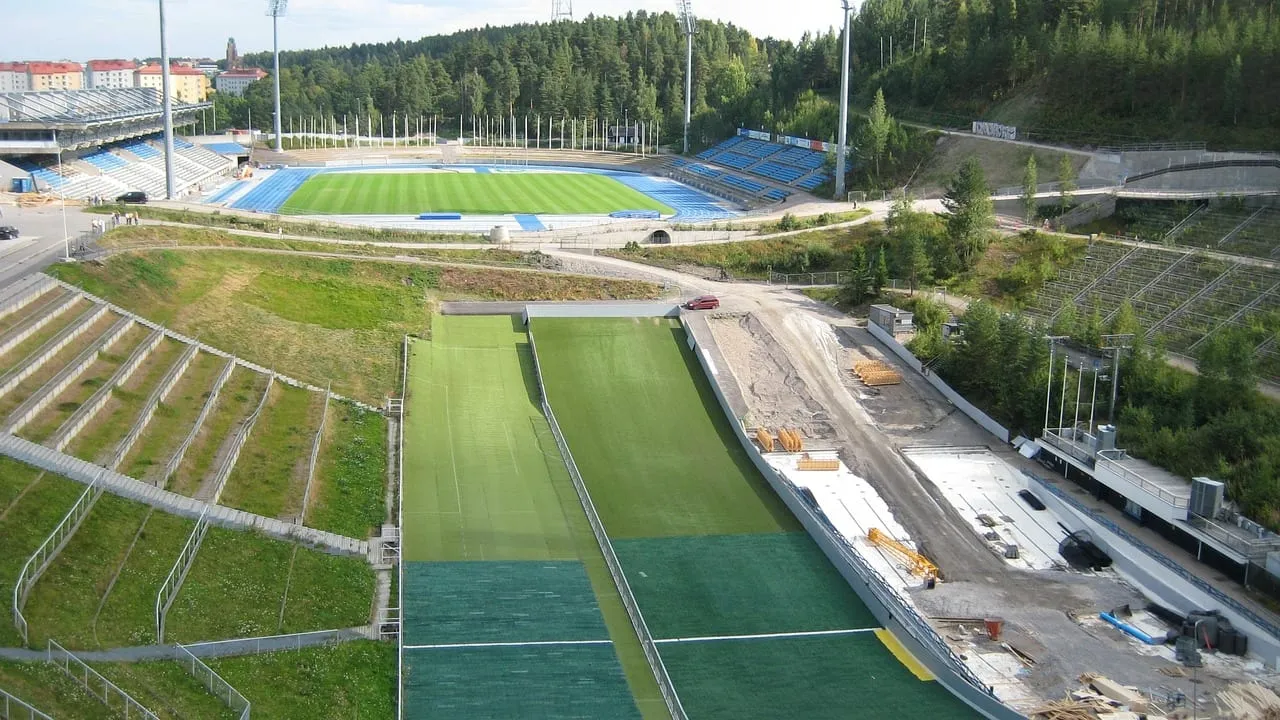
Finlandia-hiihto (Finlandia Ski Marathon, "Finski") is Finland's largest mass ski race and a Worldloppet member race since the series began: a weekend in Lahti with 62, 32 and 20 km in classic technique on the Saturday and the same distances in free technique on the Sunday, starting and finishing in the World Cup ski stadium under the ski jumps. The planned course is a 62 km loop over the Salpausselkä ridge, but the distances change with the snow: in 2025 the long race was two laps of about 34 km, and in 2026 all three days' races were cut to 42, 29 and 16 km on a 16 km loop of artificial snow. It is an open, friendly event rather than a hard-to-enter one; the difficulty is the cold and the length, not the cut-offs.
Official site (opens in a new tab)No. 17 of 41 in the toughness ranking
The race in brief
- Distance
- 62 km
- Climb
- 450 m
- Format
- 62 km loop, classic technique on Saturday and free technique on Sunday, start in four groups ten minutes apart from the Lahti ski stadium; 32 km and 20 km single starts later in the morning; a 20 km youth class, a relay and a team race
- When
- Third or fourth weekend of February; 20–21 February 2027
- Mid-pack time
- 5 h 26 min (median finisher, 62 km classic, 2024, the last edition on the full 62 km course); 5 h 21 min on the two-lap 66 km course in 2025; 3 h 24 min on the shortened 42 km in 2026
- Cut-off
- Pit stops close in sequence: Hälvälä 12:30, Messilä and Orinkarkaus 13:30, Papinkaivo 14:30, Heinsuo 16:00, Tapanila 17:00; the finish closes at 17:30, 8 h 30 min after the 09:00 start (2027 guide, pre-release)
- Entry fee
- €90–160 (62 km, 2027 edition, in five steps from 1 April 2026 (€90) to race week (€160); 32 km €70–120, 20 km €40–60; €40 off if you enter both 62 km races)
- Field
- 1,147 finishers in the Saturday 62 km classic and 933 in the Sunday 62 km freestyle (2025); 2,992 finishers across all races in 2026 and 3,175 in 2025 (official results archive)
- First held
- 1974
- Other distances
- 62 km classic (Saturday) · 62 km freestyle (Sunday) · 32 km classic and freestyle · 20 km classic and freestyle · 20 km youth M/W16 · 62 km relay in teams of three · Team race (three fastest of a team)
- Organiser
- Finlandia-hiihto (Lahti Ski Club and Hollola Athletics -46)
Next edition: 2027-02-20 · 54th edition; classic on Saturday 20 February, freestyle on Sunday 21 February. Entries opened 1 April 2026 and stay open until half an hour before each start; the price rises in five steps, the last on 1 February 2027 · Entries (opens in a new tab)
Checked 2026-10-14
How tough is it?
Four meters, each 1 to 5, rated by our published method. The basis under each one shows the figures behind the score. How we rate.
Median finishing time 5 h 26 min of 1,206 finishers in the 62 km classic of 2024, the last edition on the full course (official results archive, results.finlandiahiihto.fi, 2024-02); 5 h 21 min of 1,147 finishers on the 66 km two-lap course in 2025. Winners around 2 h 50 min to 3 h 05 min; the 90th percentile about 7 h 05 min; the last finishers 8 h 30 min to 9 h 25 min. The freestyle 62 km is about 25 min quicker at the median (4 h 59 min, 2025). As of 2025-02.
Groomed classic track over 62 km with 450 m of total climb (Worldloppet course page, 2026-10), about 7 m per km, over and around the Salpausselkä ridge: a climb straight after the start over the ski bridge, repeated short ridge climbs, the Intiaanikukkula World Cup hill as the last climb and a steep, twisting descent into the stadium that the organiser's guide warns about. Two to three set tracks, four to five on some sections; the left track is for passing. As of 2026-02.
February in Lahti: mean −6.3 °C, mean daily high −2.9 °C and low −9.8 °C (FMI 1991–2020 normals as published on Finnish Wikipedia, read 2026-10). Race days have ranged from +1 to +2 °C (2024) and −1 °C with 8 m/s gusts (2025) to below −20 °C in the morning (Saturday 2026) and −13 °C (Sunday 2026). Jury convenes if the forecast is −17 to −20 °C and may postpone the start; youth limit −15 °C. No mandatory clothing, but the guide recommends covering the face and boots. As of 2026-02.
Finish closes 17:30, 8 h 30 min after the 09:00 start, with pit-stop closing times from 12:30 at Hälvälä to 17:00 at Tapanila (2027 guide, pre-release, 2026-04); a skier at the 90th percentile pace (about 7 h) is well inside. Entries stay open until half an hour before the start and have not sold out; no lottery, no qualifying time, only self-chosen start groups. The results archive lists finishers only, so the DNF share is not published. As of 2026-04.
The course
Start and finish are in the Lahti ski stadium at the foot of the three ski jumps, less than a kilometre from the town centre. The 62 km starts at 09:00 in four groups ten minutes apart (elite and the "chase" group with the first group), and the first thing you meet is a climb over the ski bridge out of the stadium, which the organiser asks you to take with care because the field is still bunched. The course then heads west along the Salpausselkä ridge through Hollola, with pit stops at Messilä, Hälvälä (in a military training area), Orinkarkaus, Papinkaivo and back past Orinkarkaus, Heinsuo and Tapanila before the finish.
The route changed for 2025 to take out open field sections that lose snow first and to move the Orinkarkaus pit stop to a junction so that it serves skiers in both directions; before that there was a gap of more than 10 km between Papinkaivo and Heinsuo. Total climb on the main race is about 450 m, taken as many short ridge climbs rather than one big one. The race ends over Intiaanikukkula, the last hill of the World Cup course, followed by a descent that the organiser describes as relatively steep and twisting; since 2024 skiers continue about 30 m past the J-bend before dropping to the stadium at a lower speed. The men's race has been decided on that last climb in both 2025 and 2026.
Be ready for the course not to be the course. Lahti has little snow security: in 2025 the 62 km was two laps of about 34 km on the 32 km route, and in 2026 the organiser made about 10,000 cubic metres of snow for a 16 km loop skied three times as a 42 km race. On a lap course the start is staggered so that the first group is on its last lap before the later groups start, and the two-lap format sends you back past the ski jumps instead of through the stadium.
Timing is a MYLAPS ankle chip, collected at the line (there is an €80 charge if you lose it). Pit stops serve water, sports drink and energy sweets plus blueberry soup, pickles, meat broth, coffee, bread and buns; each one has spare poles and a waxing table, and a snowmobile sweeps the course behind the last skier. Medal and a finisher's cup at the line; hot meal and sauna back at the race centre.
How to enter
Entries for the 2027 race opened on 1 April 2026 on the organiser's site and stay open until half an hour before each start; you can even enter at the race office on the day with card or cash. The race does not sell out. Start groups for the 62 km are elite (bibs 1–100, the only group with a numbered order), a chase group and groups 1 to 4; you pick a group when you enter, places are first come first served and a full group cannot be guaranteed. The 32 km and 20 km have single mass starts later in the morning.
Fees for the 62 km in 2027 rise in five steps: €90 until 30 June 2026, €110 until 15 October, €130 until 15 December, €140 until 31 January 2027 and €160 from 1 February until race week. The 32 km is €70 to €120 and the 20 km €40 to €60. Entering both 62 km races (classic and freestyle) takes €40 off the total; a relay entry is the 62 km fee plus €30, the team race costs nothing extra. The fee includes the bib and gear bag, guarded ski and kit storage, waxing and spare poles at the pit stops, the feed stations, a hot meal, sauna, a medal for finishing inside the limit and basic group accident insurance. Card payment only (Visa and Mastercard).
There are no refunds if you withdraw, but if you cancel before 31 December you can carry 50 % of the fee to the next year's race, and with a doctor's or nurse's certificate sent by 31 March you get 50 % back. If the course is shortened for snow or weather there is no refund or discount. You can move to a shorter distance free of charge and to a longer one by paying the difference until the Thursday of race week by email; from Friday changes and person-to-person bib transfers are done at the race office for €10. No federation licence or club membership is needed.
How to train for it
Build the hours for five to seven hours on skis
A mid-pack 62 km finisher is out for about five and a half hours and the 90th percentile skier for seven, so long classic sessions of three hours and more, with food every 30 to 40 minutes, matter more than speed. If your home snow is poor, roller-ski sessions on rolling roads cover the double-poling and the climbing muscles.
Practise short, repeated ridge climbs
The 450 m of climb is spread over dozens of short rises on the Salpausselkä ridge rather than one long hill. Train diagonal stride and herringbone on short, steepish climbs done in series, and practise changing between double poling on the flats and striding on the rises without losing rhythm.
Rehearse grip waxing for cold and for mild snow
Lahti race days have run from +2 °C to below −20 °C in the last three editions, and the classic technique rule is enforced. Learn to wax your own skis for both hard cold tracks and warm, transformed snow, or use skins; the waxing tables at the pit stops are there for repairs, not for finding your grip at 20 km.
Train and dress for skiing in the minus teens
February mornings in Lahti are often around −10 °C and the jury only meets at −17 °C, so do your long sessions in real cold. Test a face cover, over-boots and a mitten-plus-liner system before race day, and practise eating and drinking without stopping, because fingers go numb quickly when you fiddle with gels at a pit stop.
Do some of your long sessions on a loop
When the snow fails, the race is run as laps of a 16 to 34 km loop and you pass the stadium area between laps. Train on a loop you ski several times so that you know how to keep pace on the second and third pass instead of letting the known distance to go slow you down.
What you need
- Classic skis with grip wax or skins for Saturday; the technique control disqualifies skating in the classic race, and there may be no set classic track on the Sunday freestyle day
- Poles no longer than 83 % of your height in ski boots for the classic race (FIS rule 343.8.1, checked by the jury); a spare pair is in your kit storage, and the pit stops lend spares
- Fluoro-free glide and grip wax: the race is a FIS race with a fluoro ban and tests the top skiers after the finish
- A wind-blocking front layer with a breathable back; the organiser advises recreational skiers against thin racing suits
- Face protection (buff, tape or a face mask) and goggles for a start below −15 °C, plus over-boots or boot covers and wool socks
- Lobster mitts or mittens with a spare pair of gloves and a spare hat in a pocket
- A small tin of grip wax and a cork carried in the race, as the guide recommends
- Your own gels or bars for the gaps between pit stops; the "gel area" 50 m either side of each station is the only place to drop wrappers
- A drybag or the organiser's plastic gear bag with warm, dry clothes for after the finish and for the sauna
- The 112 Suomi emergency app on your phone, which the organiser recommends installing
Getting there and staying
Lahti is about 100 km north of Helsinki. From Helsinki-Vantaa airport take the train (one change or a direct service via Tikkurila; about 50 minutes from Tikkurila, an hour from Helsinki, every half hour) or a bus of about 1 h 30 min; both arrive at Lahti Travel Centre, which is under a kilometre from the town square and a 15-minute walk from the ski stadium. Since 2026 the race has a partnership with Viking Line for skiers arriving by ferry from Sweden or Estonia. Parking at the venue is limited and the organiser asks you to car-share or use local buses.
The race centre is the Lahti Fair Centre (Salpausselänkatu 7), a few hundred metres from the stadium: bib pick-up with your confirmation email or ID, the Vauhti waxing service (bring skis the day before), guarded ski park, kit storage, expo, dining hall and ski bar. It is open Friday 10:00–19:00 and 07:30–18:30 on race days. Friday evening has a ticketed pasta party at 19:00, included for Worldloppet Masters, and a Worldloppet lounge opens Friday afternoon and from noon on race days for passport holders, who get their stamp at the info point.
Lahti is small enough to walk: hotels, sports-college rooms, cottages and villas are booked through Visit Lahti and the organiser says to book well ahead. Rental classic or skate skis, boots and poles can be booked from the organiser's shop and picked up at the CustomSki store on the first-snow track behind the big ski jump. After the finish the men's sauna is under the ski-jump grandstand and the women's at the Lahti swimming hall 200 m from the race centre (free with your bib, closes 17:30); the meal ticket is in your bib envelope and the dining hall serves until 18:00.
History
The race was the idea of Erik Pihkala of Suomen Latu, the Finnish outdoor association, who was asked at Marcialonga why Finland had no race like Vasaloppet. Lahti Ski Club, which already ran the Salpausselkä Games, took on the organisation with Suomen Latu, Hämeenlinna Ski Club and the Finnish Ski Association, and the first Finlandia-hiihto was skied on 24 February 1974 from Hämeenlinna to Lahti over 75 km with 1,334 starters, President Urho Kekkonen as patron and Olympic champions Franco Nones and Ole Ellefsæter in the field. The field peaked at 13,226 in 1984. The name joins Sibelius's Finlandia hymn to hiihto, skiing; since 2020 the polar-bear mascot Finski has been in the logo.
Finlandia-hiihto is a founding member of Worldloppet. The 50th anniversary in 2023 was marked with a 75 km Perinne-Finlandia on the original route and a moonlight 32 km skate race. From 2025 the two 62 km races are also Ski Classics Challengers events, which brings professional long-distance teams to the front of the field; the men's winning times fell from 3 h 04 min in 2024 to 2 h 51 min in 2025.
Where to find out more
- Finlandia-hiihto registration and prices (opens in a new tab): The organiser's entry page with the five price steps, what the fee includes and the cancellation terms.
- Guide to Finlandia-hiihto 2027 (PDF) (opens in a new tab): The organiser's English participant guide: race centre, start procedure, pit-stop closing times, rules and after the finish. Marked pre-release.
- Results archive (opens in a new tab): Official results for every edition since 1974, searchable by year, distance and name.
- Worldloppet: Finlandia-hiihto (opens in a new tab): The federation's race page with the course profile, history and travel notes; the race counts for the Worldloppet passport.
- Visit Lahti: Finlandia Ski Marathon (opens in a new tab): The regional tourist office, which the organiser points to for accommodation in Lahti.
Questions about Finlandia-hiihto
Is the race really 62 km?
Only when there is enough snow. The planned long course is a 62 km loop, but in 2025 it was skied as two laps of about 34 km (about 66 km) and in 2026 the long race was 42 km on a 16 km loop of artificial snow. The organiser decides in the weeks before the race and does not refund the fee if the course is shortened.
Can I ski both the classic and the freestyle 62 km?
Yes: the classic races are on Saturday and the freestyle races on Sunday, and entering both 62 km races takes €40 off the combined fee (2027 prices). The organiser notes that the classic track may not be set on the Sunday, and the elite skiers who do both have been slower on day two.
How cold does it get, and is there a limit?
The February mean in Lahti is about −6 °C, but the 2026 classic day started below −20 °C and the freestyle day at −13 °C. If the forecast is between −17 and −20 °C the jury meets early on race morning and announces any change of start time at 06:00; for under-16s the limit is −15 °C.
What are the cut-offs for a slow skier?
The 2027 guide lists pit-stop closing times from 12:30 at Hälvälä to 17:00 at Tapanila and a finish closing at 17:30, which is 8 h 30 min after the 09:00 start. In 2025 the last 62 km finisher was timed at 9 h 24 min, so the limits are applied with some leniency, but a skier arriving after a station closes must stop and is driven back to the race centre.
Do I need a licence or a club?
No. Entry is open to anyone and nothing in the entry terms asks for a federation licence or club membership. The entry fee includes a basic group accident insurance through the organiser (2027 registration page).
Does it count for Worldloppet?
Yes, Finlandia-hiihto is a founding member race and the 62 km, 32 km and 20 km all appear in the official results; passport holders get their stamp at the info point in the race centre and have access to the Worldloppet lounge. Worldloppet Masters get the Friday pasta party included.
Similar races
Sweden · Ski
Vasaloppet
Sälen (Berga by) to Mora, Dalarna
90 kmFirst Sunday of March (7 March 2027)
Norway · Ski
Birkebeinerrennet
Rena to Lillehammer, Innlandet
53 kmA Saturday in mid March; 20 March 2027 (87th edition)
Iceland · Ski
Fossavatnsgangan
Seljalandsdalur above Ísafjörður, Westfjords
50 kmThe last Saturday of the Icelandic winter, mid April: 18 April 2026, 17 April 2027, 8 April 2028, 14 April 2029
Sources
Figures and rules on this page come from these pages, read on the dates given. Organisers change dates, fees and rules: check the official site before you enter.
- Finlandia-hiihto home page (dates, 54th edition) (opens in a new tab) (read 2026-10-14)
- Finlandia-hiihto: Registration, price list 2027, included services, travel, cancellation policy (opens in a new tab) (read 2026-10-14)
- Finlandia-hiihto: Program 2027 (preliminary schedule, start groups) (opens in a new tab) (read 2026-10-14)
- Finlandia-hiihto: For skier (guide, venue, start arrangements) (opens in a new tab) (read 2026-10-14)
- Guide to Finlandia-hiihto 2027, English PDF, pre-release updated 2 April 2026 (opens in a new tab) (read 2026-10-14)
- Finlandia-hiihto: History (opens in a new tab) (read 2026-10-14)
- Finlandia-hiihto news: Distances shortened, 16 km loop (30 January 2026) (opens in a new tab) (read 2026-10-14)
- Finlandia-hiihto news: Routes to change (20 January 2026) (opens in a new tab) (read 2026-10-14)
- Finlandia-hiihto news: Q&A, frequently asked questions (3 February 2026) (opens in a new tab) (read 2026-10-14)
- Finlandia-hiihto news: Competition jury decision (7 February 2026) (opens in a new tab) (read 2026-10-14)
- Finlandia-hiihto news: Roivas and Karppanen win the 42 km classic (8 February 2026) (opens in a new tab) (read 2026-10-14)
- Finlandia-hiihto news: Niemelä and Pyykkö win the 42 km freestyle (8 February 2026) (opens in a new tab) (read 2026-10-14)
- Finlandia-hiihto news: Two 32 km loops in the long distance (13 February 2025) (opens in a new tab) (read 2026-10-14)
- Finlandia-hiihto news: Kainulainen and Karppanen win the 2025 classic races (22 February 2025) (opens in a new tab) (read 2026-10-14)
- Finlandia-hiihto news: Route info and new elements, Intiaanikukkula finish (January 2024) (opens in a new tab) (read 2026-10-14)
- Finlandia-hiihto news: The 51st classic race on National Ski Day (2024) (opens in a new tab) (read 2026-10-14)
- Finlandia-hiihto news: Viking Line partnership (2 September 2026) (opens in a new tab) (read 2026-10-14)
- Finlandia-hiihto results archive: 2024 62 km classic (1,206 finishers), 2025 62 km classic and freestyle, 2026 42 km classic and freestyle (opens in a new tab) (read 2026-10-14)
- Finlandia-hiihto 2026 live results (UltimateLIVE) (opens in a new tab) (read 2026-10-14)
- Worldloppet: Finlandia-hiihto race page (course, 450 m elevation gain, history) (opens in a new tab) (read 2026-10-14)
- Ski Classics: Finlandia Ski Marathon new route brings more snow security (12 November 2024) (opens in a new tab) (read 2026-10-14)
- Visit Lahti: Finlandia Ski Marathon (opens in a new tab) (read 2026-10-14)
- Finnish Wikipedia: Lahti, climate table (FMI normals 1991–2020) (opens in a new tab) (read 2026-10-14)