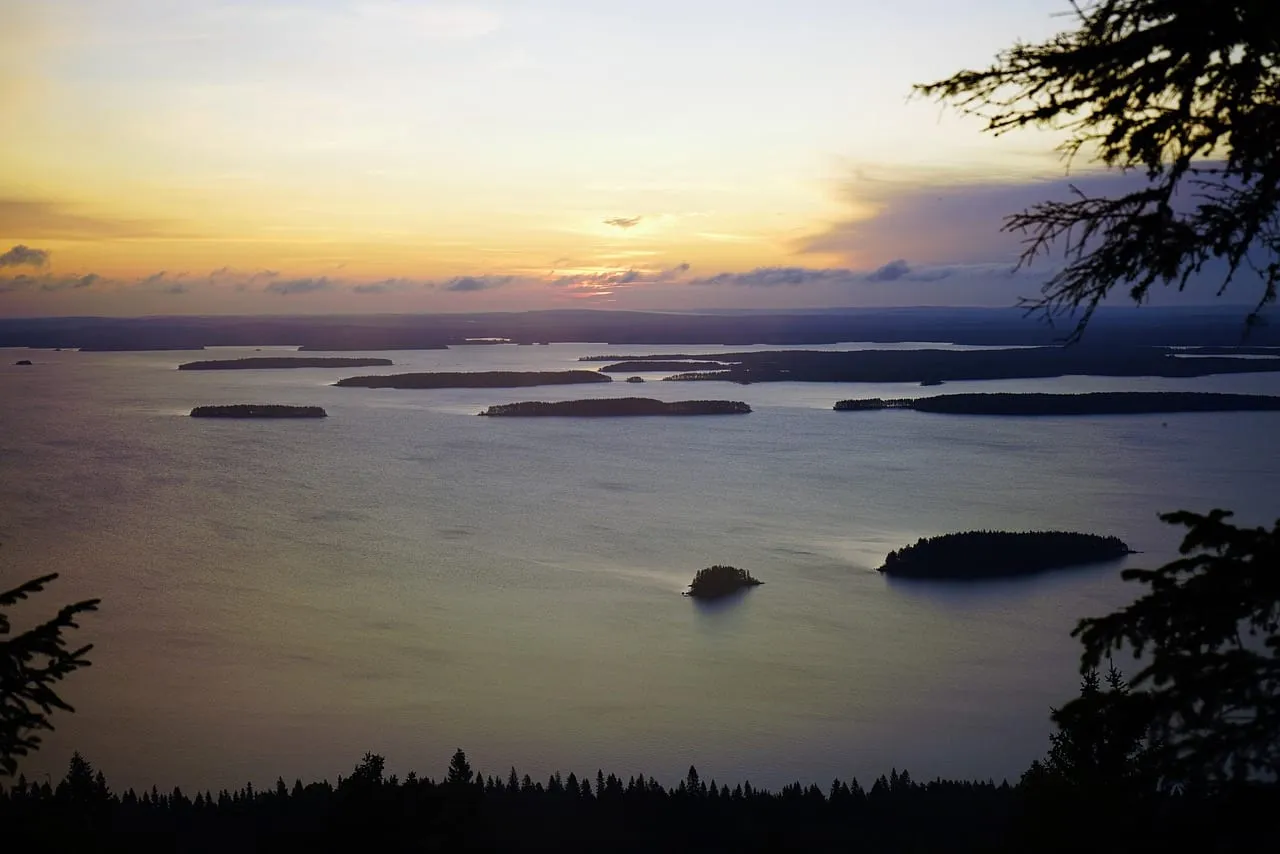
Finland · Trail running
Vaarojen Maraton
Koli National Park, North Karelia
Vaarojen Maraton (the Marathon of the Hills) is Finland's oldest trail race: a rocky, rooty 43 km loop out of the Koli hills in the first weekend of October, with a boat crossing at half way and a climb back to the summit at the end. It closes the Finnish trail season as the final of Trail Tour Finland, and the field of 1,600 across five distances (2026) sells out every year. The real picture for a first-timer: a mid-pack runner is out for seven to eight hours, there is only water on the course, and the autumn weather can be anything from frost to mild rain.
Official site (opens in a new tab)No. 18 of 41 in the toughness ranking
The race in brief
- Distance
- 43 km
- Climb
- 1,204 m
- Format
- 43 km loop (44.8 km as measured by ITRA) from the summit of Koli; race start 09:00, rolling starts 09:00–09:30; a 50 m strait crossed by rowing boat or pull-ferry at 17 km
- When
- First weekend of October (Friday evening ultra start, Saturday for the other distances)
- Mid-pack time
- 7 h 21 min (median finisher on the 43 km, 2026)
- Cut-off
- Must leave the Kiviniemi water point (17 km) by 17:00; the finish closes at 24:00, 15 h after the start
- Entry fee
- €100 (One flat price for the 43 km in 2026; no early-bird steps. 130 km €160, 65 km €110, 21 km €65, 7 km €40)
- Field
- 500 starters on the 43 km, 474 finishers with a time; about 1,600 entrants across all distances (2026)
- First held
- 2006
- Other distances
- Vaarojen Ultra 130 km (Friday 18:00, 30 h limit, 100 places, qualification required) · Vaarojen Extreme 65 km (Saturday 07:00, 17 h limit) · Vaarojen Maraton 43 km · Vaarojen Puolikas 21 km · Vaarojen Pyrähdys 7 km
- Organiser
- Karelian Seikkailu-urheilijat ry (Karsu)
Next edition: 2027-10-01 · 1–2 October 2027 is announced on the organiser's site. Entries for recent editions opened on a Sunday evening in late January (26 January 2025 at 20:25 for the 2025 race) and the 2026 race was sold out well before race day; the 2027 opening date was not yet published in October 2026 · Entries (opens in a new tab)
Checked 2026-10-14
How tough is it?
Four meters, each 1 to 5, rated by our published method. The basis under each one shows the figures behind the score. How we rate.
Median finishing time 7 h 20 min 34 s on the 43 km in 2026, computed from the 474 timed finishers in the official results on raceresult (2026-10). Winner 3:25:59, first quarter under 6:20, last finisher 13:11. The organiser's own rule of thumb is road-marathon time times 1.5. As of 2026-10.
44.8 km with +1,204 m climb (ITRA measurement of the 2025 course, about 27 m per km), almost all on the Herajärven kierros hiking trail: rocks, roots, duckboards, wet gullies and short steep pitches rather than long climbs. A rowing-boat or pull-ferry crossing of the Sikosalmi strait at 17 km, a few road stretches, and a steep final climb back to the summit of Koli. The organiser's own words are trail, stones, rock; the median pace of about 10 min per km says how technical it is. Borderline 4. As of 2026-10.
First weekend of October in North Karelia. FMI monthly observations for Joensuu give October means of 1.8–6.4 °C in 2021–2025; on the 2025 race days the daily minimum was −1.5 °C and the maximum 8 °C, while 2026 was mild at 8–13 °C with rain on the Sunday. A survival blanket, phone and elastic bandage are mandatory; a waterproof shell is recommended and mandatory on the 130 km (10,000 mm). As of 2026-10.
The cut-offs are generous for the 43 km: leave Kiviniemi (17 km) by 17:00, eight hours after the start, and finish by 24:00 (15 h). 26 of 500 starters had no finishing time in 2026 (about 5 per cent). The constraint is getting in: entries open on a Sunday evening in late January and sell out quickly (Yle reported a sell-out in fifteen minutes in 2021); the organiser agrees a participant cap with Metsähallitus each year (1,300 in 2023, about 1,600 in 2026). As of 2026-10.
The course
The race starts in front of the Ukko nature centre on the summit of Koli, the hill that gives Finland its best-known national landscape, and drops almost at once towards the lake. The first kilometres pass Koli harbour on the shore of Pielinen, then the route turns south on to the Herajärven kierros hiking trail that circles lake Herajärvi: narrow forest paths over rock slabs and roots, duckboards across wet ground, and a steady rhythm of short, steep ups and downs rather than long climbs. The course is marked with signs and tape at junctions, red-taped sticks with reflectors, and the blue paint of the hiking trail.
At about 17 km you reach the Sikosalmi strait, 50 m of water that you cross either in a rowing boat rowed by volunteers or on a pull-ferry that carries three or four runners who haul themselves over. Boats go in order of arrival, the mid-pack queues, and the waiting time is not deducted from your result. Just after the crossing is the Kiviniemi farm, the southern point of the course, the first of the two water points and the one checkpoint with a cut-off (17:00). The second water point is at Peiponpelto at about 32 km; between them is the section runners remember for its twisting, stony paths. The timing splits are taken at the start, Kiviniemi, where the trail comes out on to the road after Ryläys, and the finish.
The last part climbs back up the Koli ridge to the summit, and the final ascent is steep enough that the organiser's 2025 champion called it as awful as ever. Only water is offered on the course, poured from containers into your own bottle or bladder; there are no cups and no gels, so everything you eat you carry. The finish is at the race centre by the Ukko nature centre, with the hotel sauna, a buffet meal and the prize-giving on the summit afterwards. Results are live on raceresult with split times, and a few runners carry GPS trackers.
The 130 km ultra runs the 65 km Extreme loop twice from Friday 18:00 through the night, with a wade across the Herajoki river on a cable (water usually over 30 cm deep, slippery cobbles on the bottom), a drop-bag and soup stop at the nature centre at half way with a 07:30 cut-off, and a 30 h limit. It is limited to 100 runners and requires a previous finish in a trail ultra of over 80 km.
How to enter
Entries open on the organiser's site on a Sunday evening in late January, place by place in order of registration; the 2025 edition opened on 26 January 2025 at 20:25 and the 2026 edition was sold out long before October. The whole event is capped by agreement with Metsähallitus, the national park authority (1,300 runners in 2023, about 1,600 entrants in 2026), so set an alarm and be logged in before the minute it opens. There is no lottery and no qualification for the 43 km. The 130 km requires a documented finish of a trail ultra longer than 80 km, named at registration.
The 43 km cost €100 in 2026, the same price all the way; the 130 km was €160, the 65 km €110, the 21 km €65 and the 7 km €40. The fee includes timing, water on the course, energy at the finish, the Saturday buffet meal at the Koli hotels, the sauna, the shuttle buses from the car parks, first aid and evacuation, and the organiser's photographs. Finnish sports-benefit payments (Smartum, Edenred, ePassi) are accepted. There are no refunds. You can transfer your place to another person free of charge up to 14 days before the race, or defer it once to the following year for €20 up to the Friday of race week at 18:00. Changes of distance are free until two weeks before the event and cost €14 after that. A dedicated Facebook group for Finnish trail runners is where cancelled places change hands; the organiser does not broker them.
How to train for it
Train on rocks and roots, not on gravel
The median runner covers the 43 km at about 10 min per km, which is a walking pace on a road. The difference is the surface: rock slabs, roots, duckboards and wet stones for hours. Do your long runs on the most technical forest trail you can find, and practise running them tired, because the twisting southern section after Kiviniemi comes at 20–30 km when your legs are already heavy.
Use the 1.5 multiplier to plan
The organiser's rule of thumb is that a flat marathon time times 1.5 gives your Vaarojen time; a 4 h road marathoner should plan for about 6 h here. In 2026 the first quarter of the field finished under 6 h 20 min and the median was 7 h 20 min, so take the multiplier as the optimistic end and carry food for the longer day.
Practise short, steep repeats
The climb is 1,204 m spread over the loop in short, sharp pitches, with the steepest at the very end on the way back up to Ukko-Koli. Hill repeats of 1–3 minutes, walked hard when they get steep, train the right muscles better than long gentle climbs. Walk the last ascent with purpose rather than trying to run it.
Eat and drink from the first kilometre
There is only water, at 17 km and 32 km, and nothing else on the course. Runners who have raced the 65 km version say the gaps between points are long enough that you should carry at least a litre and eat from the start, even in cool weather. Test the food you will carry on a four-hour trail run beforehand.
Rehearse the kit check
The organiser spot-checks mandatory kit at the finish. Run your long sessions with the race pack: phone in a waterproof bag, survival blanket, elastic bandage, your own cup, bottles or a bladder, and the shell jacket. A pack that chafes at 30 km is a problem you can solve in training.
Plan for the queue at the boats
Mid-pack runners wait at the Sikosalmi crossing while the boats and the pull-ferry work through the field in order of arrival, and the wait is not deducted. Arrive there with something to eat, a layer to put on if it is cold, and no expectation of a negative split.
What you need
- Mandatory on all distances except the 7 km: mobile phone, charged, protected from water, with the organiser's emergency number saved
- Mandatory: elastic support bandage, kept dry
- Mandatory: survival blanket (space blanket) in case you have to stop and wait for evacuation
- Mandatory: your own cup or bottle; no cups are provided at the water points and water is poured into your container for you
- Mandatory on the 130 km: head torch, reflector, waterproof shell jacket with at least a 10,000 mm water column, and the organiser's GPS tracker
- Recommended by the organiser: waterproof shell jacket, bottle or bladder, your own energy and salt, blister plasters and tape, toilet paper, running poles, the 112 Suomi app
- Trail shoes with real grip; wet rock, roots and fallen leaves are the course surface in October
- Something warm for the queue at the boat crossing and for the finish on the open summit
Getting there and staying
Koli is in North Karelia, about 70 km north of Joensuu. The nearest airport and railway station are in Joensuu; VR sells a train ticket with a connecting bus to Koli (stops at both Koli hotels), and there are limited seats, so book early. On race Saturday the organiser runs a race bus Joensuu–Koli–Joensuu (06:35 from the city, back at 17:30, €15 each way in 2026, pre-booked). Driving, the road up the hill (Ylä-Kolintie) is closed to runners' cars; park at P1 by the sports ground in Koli village and take the non-stop minibus, or at P2 by the ski slope and take the chair lift up (07:00–11:00 and 12:00–19:00; dress warmly, the ride takes ten minutes). Parking is tight and the organiser asks you to share cars.
Bib pick-up is on Friday 15:00–21:00 at the village hall in Koli village (Merilänrannantie 4C) and on Saturday 06:00–10:30 at the race centre by the Ukko nature centre on the summit; the organiser recommends Friday. A bag drop tent by the hotel takes one bag per runner, tagged with the tear-off from your bib, and is staffed from 06:00. After the finish you have the sauna at the summit hotel (Break Sokos Hotel Koli) or at the village hotel, a buffet meal at either hotel included in the fee from 11:00 to 22:00, then the prize-giving at 20:00 and the party at the summit hotel. A pasta dinner on Friday evening is sold separately.
Accommodation is the two Sokos hotels on the hill and in the village, plus cabins and holiday flats around Koli and Lieksa; the organiser's Koli page points to the local tourist office and cabin agencies. The hotels fill for race weekend, and camping or motorhomes in the national park car parks is not allowed. Joensuu is a workable base if you take the race bus.
History
The race was dreamt up in December 2005 by two members of the Joensuu adventure-sports club Karsu while hiking the snow-covered Herajärven kierros trail, with the Alpine mountain runs as the model and the deliberate choice of the worst time of year. The first edition in autumn 2006 had ten runners; fifty came in 2007 and over a hundred in 2008, and by the organiser's account the event has sold out every year since. The 130 km was meant to debut in 2015 but a storm stopped the start, and it was first run in 2016. The 2025 race was the twentieth edition and 2026 the twenty-first.
Course records on the 43 km are 3:25:59 (2026) and 4:14:36 (2020). The race is the final of Trail Tour Finland, a series of eight trail races from 21 to 55 km, and the 130 km is the final of Ultra Trail Tour Finland, whose finishers of all three ultras in one year earn the UTTF vest.
Where to find out more
- Official results on raceresult (opens in a new tab): Full 2026 results by distance with split times at Kiviniemi and the road junction after Ryläys.
- Trail Tour Finland (opens in a new tab): The eight-race Finnish trail series of which Vaarojen Maraton 43 km is the final; the 130 km closes the three-race Ultra Trail Tour Finland.
- Getting to Koli and parking (opens in a new tab): The organiser's page on the race bus from Joensuu, the VR train-plus-bus ticket, the car parks and the chair lift.
- Koli services (opens in a new tab): The organiser's pointers to the Koli tourist office, cabin agencies and the local taxi.
- Karelian Seikkailu-urheilijat (Karsu) (opens in a new tab): The volunteer adventure-sports club in Joensuu that runs the race, with about 80 members.
- ITRA race page, 43 km 2025 (opens in a new tab): ITRA's measurement of the course (44.82 km, +1,204 m) and the points awarded.
Questions about Vaarojen Maraton
Is there food on the course?
No. On the 43 km the organiser provides only water, at Kiviniemi (about 17 km) and Peiponpelto (about 32 km), poured into your own bottle or cup; there are no cups and no energy. You carry everything you eat, and outside help from supporters on the course is not allowed (2026 rules).
What is the boat crossing?
At about 17 km the course crosses the 50 m Sikosalmi strait. Volunteers row you across in rowing boats, or you pull yourself over on a cable ferry that takes three or four runners at a time. You board in order of arrival, the main pack queues, and the waiting time is not deducted from your finishing time.
How fast does it sell out, and is there a waiting list?
Entries open on a Sunday evening in late January and the event has sold out every year; Yle reported a fifteen-minute sell-out for the 2021 race, and the 2026 edition was full long before October. There is no official waiting list: places can be transferred to another person free until 14 days before the race, and a Finnish trail-running Facebook group is where they change hands.
Can I get a refund or defer to next year?
No refunds. You can defer once to the following year for €20 via your registration link, up to the Friday of race week at 18:00, or transfer your place to someone else free of charge until 14 days before the event. If the race is cancelled for force majeure the organiser keeps 50 per cent of the fee (2026 terms).
Do I need to qualify?
Not for the 43 km, 65 km, 21 km or 7 km. The 130 km is limited to 100 runners and you must name a previous finish in a trail ultra of over 80 km (for example NUTS Karhunkierros or Ylläs Pallas) when you enter.
How do I get to Koli without a car?
Train to Joensuu, then either the VR connecting bus to Koli (book it with the train ticket; it stops at both hotels) or, on race Saturday, the organiser's race bus from Joensuu at 06:35, back from the race centre at 17:30, €15 each way in 2026, booked in advance until the Wednesday of race week.
Similar races
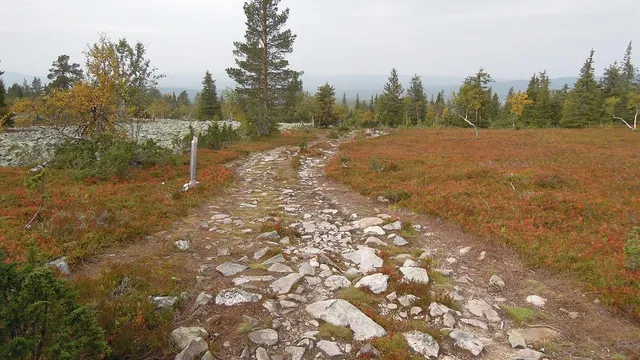
Finland · Trail
NUTS Ylläs Pallas (66 km)
Hetta (Enontekiö) to Pallas, Pallas-Yllästunturi National Park, Finnish Lapland; event centre Äkäslompolo, Ylläs
66 kmFriday 23 July 2027 (event weekend 23 and 24 July 2027; in 2026 the 66 km ran on Friday 17 July)
Sweden · Trail
Lidingöloppet
Lidingö, Stockholm
30 kmLast weekend of September; the 30 km is on the Saturday (25 September 2027)
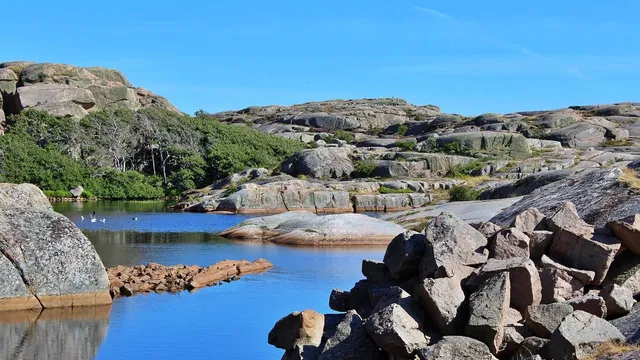
Sweden · Trail
Höga Kusten Trail
FriluftsByn, Skuleberget, High Coast (Höga Kusten), Ångermanland
45 kmLast weekend of August (the 45 km on Saturday 28 August 2027)
Norway · Trail
Birkebeinerløpet
Birkebeineren Ski Stadium to Håkons Hall, Lillehammer, Innlandet
20.2 kmA Saturday in mid June; 12 June 2027 (29th edition)
Sources
Figures and rules on this page come from these pages, read on the dates given. Organisers change dates, fees and rules: check the official site before you enter.
- Vaarojen Maraton – home page (2027 date, 2026 distances) (opens in a new tab) (read 2026-10-14)
- Vaarojen Maraton – Matkat (distances, start times, limits, fees 2026) (opens in a new tab) (read 2026-10-14)
- Vaarojen Maraton 43 km – course facts, cut-off, water points, records (opens in a new tab) (read 2026-10-14)
- Vaarojen Ultra 130 km – course facts, cut-offs, qualification (opens in a new tab) (read 2026-10-14)
- Vaarojen Maraton – Aikataulu (timetable 2026) (opens in a new tab) (read 2026-10-14)
- Vaarojen Maraton – Saapuminen ja liikkuminen (travel, parking, race bus) (opens in a new tab) (read 2026-10-14)
- Vaarojen Maraton – Tapahtumaohjeet (mandatory kit, course marking, crossing, safety) (opens in a new tab) (read 2026-10-14)
- Vaarojen Maraton – Ilmoittaudu (fees, inclusions, terms 2026) (opens in a new tab) (read 2026-10-14)
- Vaarojen Maraton – Siirrot ja myynti (transfers and deferrals) (opens in a new tab) (read 2026-10-14)
- Vaarojen Maraton – Live Center (results, GPS) (opens in a new tab) (read 2026-10-14)
- Vaarojen Maraton – Kolin palvelut (accommodation pointers) (opens in a new tab) (read 2026-10-14)
- Vaarojen Maraton 2026 results on raceresult (all distances) (opens in a new tab) (read 2026-10-14)
- Organiser news: Kisaennakko 2026 (1,600 entrants, 21st edition) (opens in a new tab) (read 2026-10-14)
- Organiser news: 1366 participants in 2025 (opens in a new tab) (read 2026-10-14)
- Organiser news: 2025 champions and results (opens in a new tab) (read 2026-10-14)
- Organiser news: Ilmoittaudu 20. Vaarojen Maratoniin (history, registration opening 2025) (opens in a new tab) (read 2026-10-14)
- Organiser news: 130 km half-way cut-off 07:30 (2026) (opens in a new tab) (read 2026-10-14)
- Organiser news: Vaarojen Maraton 2026 ruokailut (meals) (opens in a new tab) (read 2026-10-14)
- Organiser news: tips for the 65 km (2019 winner's advice on fuelling and night running) (opens in a new tab) (read 2026-10-14)
- ITRA – Vaarojen Maraton 43 km 2025 (44.82 km, +1,204 m) (opens in a new tab) (read 2026-10-14)
- ITRA – Vaarojen Ultra 130 km 2025 (123.3 km, +3,462 m) (opens in a new tab) (read 2026-10-14)
- ITRA – Vaarojen Maraton 43 km 2021 (opens in a new tab) (read 2026-10-14)
- Yle: Vaarojen maratonille odotetaan ennätyksellistä osanottoa – paikat myytiin loppuun vartissa (2021) (opens in a new tab) (read 2026-10-14)
- Yle: trail race entry fees, 1,300-runner cap agreed with Metsähallitus (2023) (opens in a new tab) (read 2026-10-14)
- Trail Tour Finland – series and 2026 calendar (opens in a new tab) (read 2026-10-14)
- Karelian Seikkailu-urheilijat ry – club page (opens in a new tab) (read 2026-10-14)
- FMI open data – monthly temperature and rainfall observations, Joensuu 2021–2025 (opens in a new tab) (read 2026-10-14)
- FMI open data – daily observations, Joensuu, 1–6 October 2025 (opens in a new tab) (read 2026-10-14)
- FMI open data – daily observations, Joensuu, 1–5 October 2026 (opens in a new tab) (read 2026-10-14)